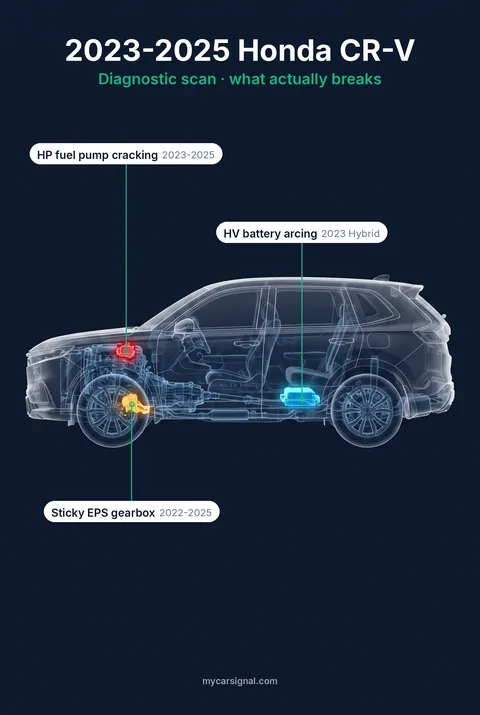
If you're shopping a 6th-gen Honda CR-V, one problem sits above everything else. The steering. Owners describe a "sticky" or "catching" feeling at highway speed, usually after a long stretch of driving, where the effort suddenly jumps and the wheel won't turn smoothly. It shows up on both the 1.5-litre turbo and the hybrid, and it shows up early. On the 2023 model, carcomplaints.com logged 368 steering complaints at an average of just 586 miles. That's not a wear item creeping in at 100,000 km. That's a defect out of the gate.
The EPS steering gearbox defect
Here's what happened. NHTSA opened a preliminary evaluation in March 2023 that grew into a full engineering analysis by November. Investigators traced the fault to deformed worm wheel teeth and inconsistent grease inside the electric power steering gearbox. By the time NHTSA counted, 13 crashes had been tied to it. Honda's first response was Service Bulletin 23-037, which called for replacing the whole EPS gearbox.
Then came the recall. NHTSA campaign 24V-744, issued October 3, 2024, swept in more than 1.6 million Honda and Acura vehicles, including 2023-2025 CR-V and CR-V Hybrid, with owner letters mailing November 18. The remedy is lighter than the original bulletin: dealers replace the worm gear spring and add or redistribute grease rather than swap the entire gearbox. The repair is free. The catch for used buyers is out-of-pocket cost outside that recall, where replacing a full steering rack or gearbox has run $2,000 to $3,000 USD. Some owners have also been hit with a surprise four-wheel alignment fee, around $150 to $180 USD, because dealers won't hand the car back without one.
The important part: this was never fixed by a mid-cycle production change. The investigation expanded to include the 2024 model, and the recall spans 2022 through 2025. Steering makes up roughly 46% of all NHTSA complaints across the generation. So don't assume a newer model year escaped it. Ask for proof the 24V-744 recall was completed. If it wasn't, budget for a dealer visit and check the steering feels linear on a highway test drive.
Hybrid recalls and the fuel pump
The hybrid carries its own list. The one to know is the high-pressure fuel pump. A defective pump core can crack during operation, leading to fuel leaks, a fuel smell, and fire risk. The chips came from a machining problem at supplier Hitachi Astemo, and the scope is large: roughly 720,000 U.S. vehicles starting with the 2023-2025 CR-V Hybrid. In Canada it's Transport Canada recall 2024606. Two smaller hybrid recalls hit the 2023 model specifically: a high-voltage battery module where a terminal or bus bar could break and cause arcing, and a transmission wiring fault that could cut drive power (Transport Canada flagged this on a single vehicle).
| Problem | Years / scope | Fix |
|---|---|---|
| EPS steering gearbox (sticky steering) | 2022-2025, gas + hybrid | Recall 24V-744, free (spring + grease) |
| High-pressure fuel pump cracking | 2023-2025 Hybrid | Recall (TC 2024606), free |
| High-voltage battery module arcing | 2023 Hybrid only | Recall (TC 2024585), free |
| Transmission wiring, loss of drive power | 2023 Hybrid (very low volume) | Recall (TC 2023467), free |
| Front passenger seat weld | 2023 only, ~98 units | Recall (TC 2023072), seat frame replaced |
| Side mirror vibration / cracking | 2023-2024 | No recall; TSB on mount spring |
The smaller stuff owners keep reporting
The driver's-side mirror is a recurring gripe. Owners report the glass vibrating at speeds over 65 mph, producing a shaky image, and some mirrors have cracked in cold weather with no impact. Honda started investigating in late 2023 and issued a TSB on a redesigned mirror mount spring, but as of early 2026 there's no recall covering the glass itself. A 2024 legal review put it plainly: Honda has no recall for either the vibration or the cracking.
Beyond that, expect a scattering of software and assembly niggles. There are TSBs for the lane-keep warning light coming on in reverse, for adaptive cruise and collision braking cancelling with a dashboard error, for a windshield washer system that leaks or won't spray, and for rear differential fluid leaking after a dealer over-torques the drain plug. One CR owner reported "hood flutter" on windy days that a service advisor recognized on sight. A 2024 owner needed all four fuel injectors replaced at 10,800 miles on the direct-injection engine, though that's a single report, not a pattern.
Then there's oil dilution, the ghost from the 5th generation. The 1.5T oil-dilution class action names the CR-V only through 2023, mostly the outgoing generation. Canadian owners on forums keep raising it about the new car, and one interesting owner choice: someone deliberately bought a 2022 over a 2023 because the 2022 uses port injection while the 2023 and 2024 went to direct injection, which they saw as fussier. Treat 6th-gen oil dilution as an unresolved reputational worry, not a confirmed defect at NHTSA scale like the steering.
What owners actually like, and what to buy
The praise is real too. Consumer Reports calls the gas CR-V smooth, economical, and "very reliable if cared for properly," and rates the 2024 as more reliable than other same-year cars. Hybrid owners consistently love the drivetrain: "smooth and responsive," one wrote, and another was glad they skipped the turbo. The most common hybrid complaint is trivial, the pedestrian-warning AVAS noise. iSeeCars projects the CR-V Hybrid could reach 13.8 years or 169,000+ miles before major issues. One honest caveat: CR rates the 2023 Hybrid's reliability only "about average," and there's no mature three-year dependability data on this generation yet, since JD Power's long-term study won't cover 2023 until the 2026 cycle.
On price, the Canadian market puts the median 2023 at $34,987 with about 61,000 km, the 2024 at $40,192, and the 2025 at $40,498. The steering fix is free under recall, so the cheaper 2023 doesn't carry a hidden repair penalty there, as long as the work is done. But it does carry the 2023-only extras: the seat-weld recall and the heaviest concentration of very-low-mileage steering complaints. Pull the VIN and confirm every open recall is closed before you sign, especially 24V-744 and the hybrid fuel pump. Test the steering on a highway loop, not just around the block. And there's no clean "buy this engine" answer here: the hybrid wins on refinement but sits at about-average reliability, while the 1.5T carries the oil-dilution shadow. Pick on drive feel, and let the recall paperwork make the decision safe.
What these Honda CR-V years cost right now
Live Canadian price benchmarks for every year in this generation:
2023 CR-V prices2024 CR-V prices2025 CR-V prices2026 CR-V prices