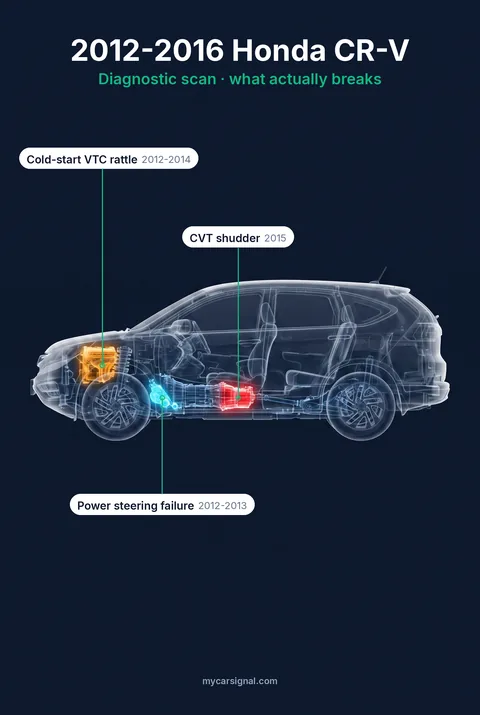
The 4th-generation CR-V is one of the more dependable compact SUVs you can buy used, but it isn't spotless. Two problems dominate the record, and they split cleanly by year. Early cars (2012-2014) get a cold-start engine rattle. The 2015, the first year Honda dropped a CVT into this platform, got a shudder bad enough to spawn a class-action lawsuit. Know which car you're looking at and you can steer around most of the trouble.
The cold-start rattle: 2012-2014
This is the best-documented issue on the generation. You start the car cold, and for roughly two seconds the engine rattles before settling. The usual culprit is the Variable Valve Timing Control (VTC) actuator, sometimes the timing chain tensioner. Honda covered it under Technical Service Bulletin 09-010.
Coverage is where it gets murky. One reading of the bulletin lists 2012-2013 CR-Vs; another says all 2007-2012, some 2013 (check the VIN), and all 2014 models, 2WD and 4WD. So the exact cutoff depends on the specific vehicle, and a dealer VIN check is the only way to know for sure. Owners also report that dealers sometimes wave the noise off as normal and dispute warranty coverage, which is worth knowing before you walk in. A separate rattle bulletin surfaced in late 2016 for the direct-injection K24W engine family in 2015-2016 CR-Vs, so the noise isn't strictly an early-car thing. The two bulletins appear to cover different engines, and the relationship between them isn't fully clear from the paper trail.
The 2015 CVT shudder
The mid-cycle refresh in 2015 swapped the old 5-speed automatic for a CVT, and the first batch had problems. Owners describe a rough vibration or chatter from the transmission when the tach sits between 1,000 and 2,000 rpm, at any road speed. Some report a nastier version: after the car sits 24 hours or more, shifting into reverse on a cold start brings a shudder and sometimes a stall. It's random and hard to reproduce on a test drive.
Dealers frequently told owners this was just how the CVT behaves and that nothing could be done. A class-action lawsuit followed. One suggested owner mitigation is more frequent HCF-2 CVT fluid changes. Owner anecdote suggests the units that ran clean early tend to stay clean, so a 2015 with a documented history and no shudder complaints is a safer bet than one you're driving for the first time. That's owner speculation, not engineering fact, but it lines up with how these failures showed up.
The 2016 scores noticeably better in third-party ratings. J.D. Power gave it 83 out of 100 ("great"), and it's ranked as one of the stronger CR-V years overall. Honda addressed the CVT issue after 2015, though the exact fix wasn't spelled out in what we found. If you're choosing between a 2015 and a 2016 and the prices are close, the 2016 is the easier call.
The rest of the record
A few other issues show up. The 2012 had a recall for a door handle and lock cable: pull the handle while locking and the cable can slip out of position, leaving the door not properly latched. That campaign covered 172,837 vehicles. A separate goodwill TSB covered noisy or failing door lock actuators for free through November 2015. Early cars (2012-2013) also drew power steering complaints, including full electric power steering (EPS) failures where the wheel goes stiff and the dash warning lights up. Some cases traced to the EPS control module rather than anything mechanical, since reprogramming brought it back temporarily before failing again.
AC compressor failure gets mentioned constantly across the whole CR-V line, this generation included. The clutch wears out, and when the compressor lets go it can spread debris and sludge through the whole system, which balloons the repair. In the US, RepairPal pegs a 2012 CR-V compressor replacement at $765 to $1,673, and up to $1,820 across the model. Worth noting: a lot of SEO sites talk about an "AC compressor recall," but no official NHTSA or Honda recall for it turned up. Treat that as internet myth, not fact. Clear-coat peeling is another recurring owner gripe, though opinions split on whether it's worse here than on rivals.
One quirky repeat complaint: rodents nesting in the cabin air intake, which produces its own rattle on startup. Check the cowl if you hear something odd.
Now the good news, and it's real. Owners routinely take these past 200,000 miles with little more than sensors, bushings, a CV axle, and a caliper. One 300,000-mile account called it low-maintenance across its whole life. And a genuine plus for this specific generation: Honda Canada's Takata airbag document lists CR-V coverage as 2002-2011, which suggests the 2012-2016 cars largely sat out the big driver and passenger inflator recall that hit so many Hondas of the era. Verify with a live VIN lookup, but that's a meaningful point in this generation's favour. (The 2016 did get a narrow driver-airbag housing recall for cars built October 12-19, 2015.)
What to buy, what to check
On the Canadian market the 2013 sits at a median of $11,125, the 2014 at $13,495, the 2015 at $15,995, and the 2016 at $15,738. The 2016 costs about the same as the 2015 but shows up with lower median mileage (roughly 128,000 km versus 168,000 km) and the better reliability record. That's the pick of the generation if the budget stretches. If you want cheap, a 2013 or 2014 with the old 5-speed automatic avoids the CVT question entirely; just cold-start it and listen for the VTC rattle, and get the VIN checked against TSB 09-010.
Test-drive priorities: start the car stone cold and listen for two seconds of rattle. On a 2015, watch for shudder between 1,000 and 2,000 rpm and, if you can, check reverse on a cold engine. Confirm the power steering feels normal at low speed on early cars. Ask for CVT fluid service records on any 2015. And run the VIN through Transport Canada or NHTSA for open recalls before you sign, since campaigns are cumulative and keep getting added.
What these Honda CR-V years cost right now
Live Canadian price benchmarks for every year in this generation:
2013 CR-V prices2014 CR-V prices2015 CR-V prices2016 CR-V prices