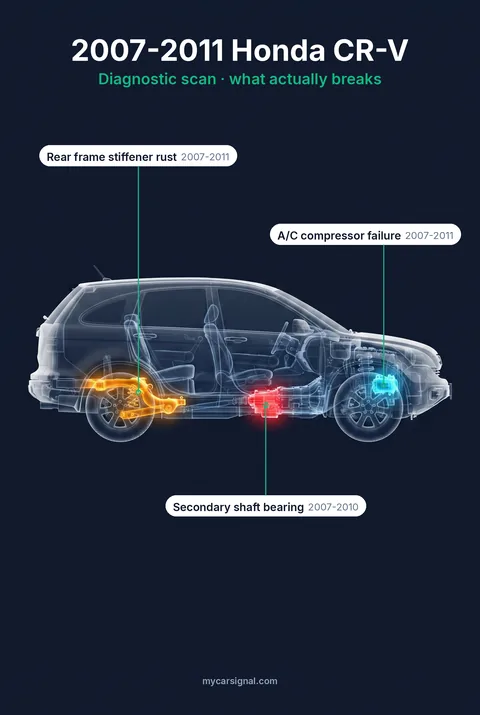
The third-generation Honda CR-V has a reputation for going the distance, and most of it is earned. The engine is the star. What actually sends these trucks to the shop tends to be smaller stuff: door locks, the A/C, paint, and one Canada-specific problem that matters more than all of them combined.
If you buy one in the salt belt, read the section on frame corrosion first. It's the difference between a $9,000 runner and a car that fails inspection.
The rear frame rust recall (this is the big one)
Honda recalled roughly 83,953 model year 2007–2011 CR-Vs in Canada over excessive corrosion to the rear frame stiffeners. Salt does the damage. In extreme cases the frame stiffener perforates and the rear trailing arm can separate from the body while you're driving, which is exactly as dangerous as it sounds.
It didn't go away. A larger 2023 Transport Canada recall covered 110,504 CR-Vs from the same 2007–2011 run for the identical issue. Honda's Element and Ridgeline got nearly the same recall, so this is a known weakness in how Honda built these frames for winter climates. The inspection and repair (a support brace, or a frame repair) is free, and Honda pegs it at about an hour and a half of work.
Here's the catch. The recall fix mitigates the safety risk if corrosion is found. It does not reverse rust that's already there. A car that's spent a decade of Ontario or Quebec winters can still be too far gone. Get it on a hoist before you buy and look hard at the rear frame rails and trailing arm mounts.
Door locks, A/C, and paint
The most-cited complaint on this generation is the door lock actuator. It's common enough that it drove a class-action lawsuit Honda settled in 2014. Symptoms: erratic locking and unlocking, a buzzing noise from inside the door, or one door's power lock quitting entirely. The lawsuit noted the failures usually hit after the 3-year/36,000-mile warranty was up. Owners reported roughly $300 to $400 (USD) per repair, and the actuators aren't interchangeable, so the shop has to match the exact door position.
The A/C compressor clutch was enough of a pattern that Honda issued TSB 12-072 and extended the clutch warranty to 7 years or 100,000 miles. Covered symptoms were warm air, poor cooling, or noise from the compressor area. Worth noting this is a milder problem than the notorious "Black Death" compressor failure on the older 2002–2006 CR-V. Different generation, different problem.
Then there's the paint. Honda TSBs from 2013 covered cracking and peeling clear coat on 2007–2011 CR-Vs, mostly on the roof and the leading edge of the front fenders, spreading to the trunk and upper door and quarter panels. Several black, blue, and pearl metallic colours were specifically named. Owners describe the finish going chalky or cloudy and needing a repaint.
The transmission recall and airbags
Here's the one genuinely year-specific problem. Honda recalled 2007–2010 CR-Vs (the 2011 was left out) over a secondary shaft bearing whose outer race could break during certain driving. That could throw the check engine light, cause a short circuit and stall the engine, and in the worst case let broken pieces jam the parking pawl so the car rolls after you've shifted to park. If you're looking at a 2007 through 2010, confirm this recall was completed.
The Takata airbag saga also caught this generation. Honda's Canadian recall list includes 2007–2011 CR-Vs for front inflator replacement, and later U.S. campaigns covered remedy-part inflators that could degrade and fire metal fragments into the cabin. This was industry-wide, not a CR-V flaw, and any Honda dealer replaces the inflators for free. Just verify it's been done.
What holds up
The 2.4L K24 four-cylinder, the only engine sold here, is the reason people trust these. Reviewers point out most 2007 engine complaints were minor, with none amounting to a major repair, and K24s routinely clock past 200,000 miles on regular maintenance. Consumer Reports commentary singles out the 2008 as the generation's high point. Engine trouble, when it shows up, usually waits until 100,000 to 150,000 miles.
One odd note to keep in mind: the 2011 draws the highest complaint volume in owner databases, including a pattern of the engine revving under braking. That sits awkwardly against the "most reliable generation" praise, so treat a 2011 with a little extra scrutiny on a test drive.
Which years to buy, and what to check
Prices tell you where the value sits. The 2008 median sits around $9,003 with about 194,000 km on it. A 2010 runs a median near $8,450 but with heavier mileage around 237,000 km. The 2011 commands a real premium at roughly $13,698, largely because the typical example has only 151,000 km. Whatever you save on a cheap early car evaporates fast if the frame needs work the recall can't fully undo.
Put every candidate on a hoist and inspect the rear frame rails and trailing arm mounts for perforation. Confirm the frame corrosion recall and, on a 2007–2010, the transmission bearing recall were both completed. Test every door lock, run the A/C hard, and look at the roof and front fender edges for clear-coat failure. Get one that passes those checks and you've got a truck with an engine that'll likely outlast the body.
What these Honda CR-V years cost right now
Live Canadian price benchmarks for every year in this generation: