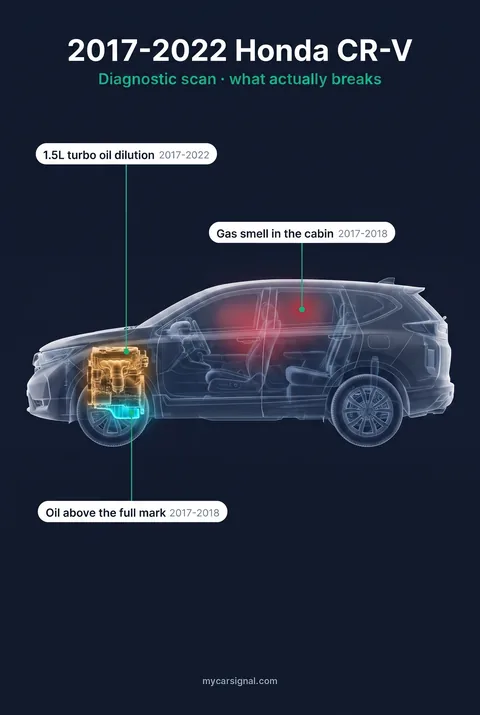
The fifth-generation Honda CR-V is a genuinely solid used SUV. But there's one issue that follows this generation around, and it's worth understanding before you sign anything: the 1.5L turbocharged engine dilutes its own oil with gasoline. This is the engine in most CR-V trims from these years, so it's not a corner case you can easily dodge.
Oil dilution on the 1.5L turbo: what actually happens
Gasoline seeps past the rings into the crankcase and mixes with the engine oil. Two symptoms give it away. First, the oil level climbs above the full mark on the dipstick. Second, owners report a gas smell, sometimes in the cabin, sometimes from the exhaust. Honda's own manager of auto campaigns and recalls told a dealer memo (reported by Consumer Reports) that the dilution could come from software settings or potential hardware failures.
Cold weather makes it worse, which matters a lot in Canada. Short trips where the engine never fully warms up are the trigger, and Honda first rolled out its fix in December focusing on five northern U.S. states: Maine, Minnesota, North Dakota, South Dakota, and Wisconsin. If you're doing winter school runs and short commutes, you're in the exact conditions where this shows up.
It shows up early, too. CarComplaints logs 488 NHTSA complaints on the 2017 CR-V engine, at an average of roughly 17,000 miles. The same pattern repeats on 2018 models. So this isn't a 200,000 km wear-out story. It's a design characteristic that can surface in the first couple years of ownership.
Is it fixed on the newer years? Not clearly.
Here's where the story gets murky, and I'd be straight with you about it. Honda released a software update (TSB 18-089) that adjusts fuel injection timing and prioritizes warming the engine over heating the cabin, and one source says that significantly reduced the problem. But other outlets say the fix never fully took. Reports of oil dilution on the 1.5 turbo continued into 2021 and 2022, and one 2022 owner reported gas smell and dilution multiple times at only about 6,000 miles (a single forum account, not aggregate data). Owner opinion is split down the middle: some say a 2021 update solved it, others with nearly-new 2020s still smell gas in the oil.
The honest read: treat any "fixed in 20XX" claim as disputed, not settled. Buying a newer year lowers the odds but doesn't guarantee you're clear.
| Issue | Years | What you'll notice |
|---|---|---|
| 1.5L turbo oil dilution | 2017–2022 (worst documented on 2017–2018) | Oil above full mark, gas smell in cabin/exhaust, worse in cold weather |
The warranty angle is the good news
Honda extended factory warranty coverage for oil-dilution issues under a Canadian settlement. The extension runs to six years after the original sale or lease date, with no mileage limit on the affected components. That's genuinely useful. If you're looking at a 2017 or 2018, check the original in-service date and whether that six-year window is still open. In the U.S., Honda added a year to the powertrain warranty on about a million 2016–18 Civics and 2017–18 CR-Vs, for six years total on the affected parts.
On cost, there's no clean CAD figure for repairing actual dilution-related engine damage, and that's the part that stings. Routine related work runs about $122–149 for an oil change and $271–362 for a turbo oil line, but real engine damage is a different order of magnitude. This is where the price data matters. The 2017 median sits at $21,748 and the 2018 at $20,986, versus $26,993 for a 2021 and $29,995 for a 2022. A cheap early car saves you five or six grand up front, but if the dilution has already done damage and the warranty window has closed, one repair can erase that gap and then some.
What to check before you buy
Pull the dipstick on a cold engine and look for oil sitting above the full line. Smell it. Gasoline in the oil is obvious once you know what you're checking for. Ask the seller whether the TSB software update has been applied, and get the original in-service date so you can confirm how much of the six-year dilution warranty is left. On a 2017 or 2018, that warranty is the single biggest thing protecting your wallet, so prioritize cars where it's still active. Newer years like 2020–2022 cost more and carry lower reported dilution odds, but don't assume they're immune. If you want to sidestep the turbo question entirely, the 2.4L naturally aspirated engine isn't the one flagged for this problem.
What these Honda CR-V years cost right now
Live Canadian price benchmarks for every year in this generation:
2017 CR-V prices2018 CR-V prices2019 CR-V prices2020 CR-V prices2021 CR-V prices2022 CR-V prices