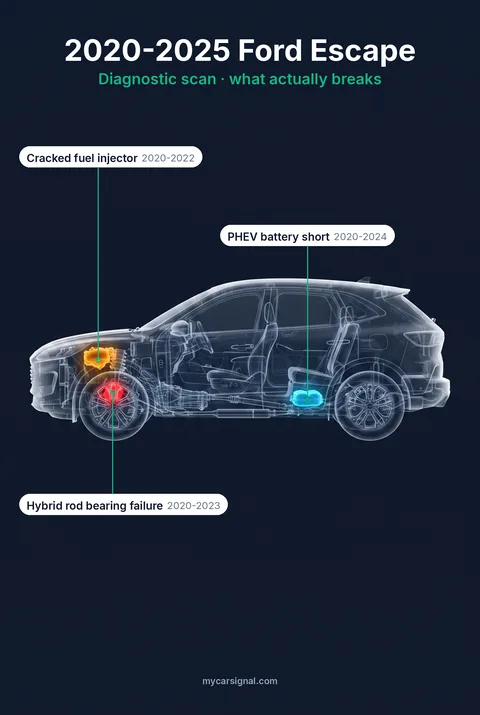
The 4th-gen Escape has a recall problem, and not the routine kind. Aggregators compiling NHTSA data count 43 separate recall campaigns and roughly 2,477 owner complaints across the 2020–2025 range, with 20 reported fires and 50 injuries. What stands out isn't just the volume. It's that Ford keeps re-issuing recalls for the same defects, which tells you the first fix didn't hold. Consumer Reports rated the 2020, 2021, and 2023 Escape as less reliable than other cars from their model years. So before you chase a cheap early one, know exactly what you're signing up for.
The fire risks: three engines, three ongoing problems
The 1.5L EcoBoost three-cylinder (Ford's "Dragon" engine) in 2020–2022 Escapes is the generation's weakest point. Two separate defects: a cracking oil separator housing that leaks oil, and cracked fuel injectors that can dump fuel onto hot exhaust parts at up to 19 litres per hour. The oil separator recall covered 345,451 units. The injector recall started at 333,342 vehicles in November 2022 and kept expanding, reaching around 858,000 Escapes and Bronco Sports by the 2025 revision. Here's the ugly part. As of the latest reporting there's still no permanent fix, only a software workaround, and Ford found injector cracking on eight vehicles that caught fire under the hood. Six of them hadn't gotten the software update yet. Owners report the engine dropping into safe mode while driving, misfires, and a whine followed by loss of power, sometimes on the highway. That one 1.5L across 2020–2022 alone drew 1,434 complaints, more than 10 times the compact SUV segment average.
The 2.5L hybrid and PHEV in 2020–2023 cars had a connecting rod bearing failure that could release oil and fuel vapour into the engine bay and start a fire. Ford's early fix was just a PCM software update. Later it moved to full engine long-block replacements, and in June 2024 it launched a Customer Satisfaction Program offering a one-time engine replacement for affected 2020–2023 hybrids. That's a real fix, and it's free. But one owner reported a dealer updating only the software without inspecting the engine, then admitting the fire risk was still there. So the fix depends on which remedy your specific car actually received.
The plug-in hybrid battery is the one still hanging open. A cell manufacturing defect can cause an internal short circuit, loss of drive power, and in rarer cases a fire. This has been recalled over and over from 2022 through early 2026, and Ford found the software fix "may not be sufficient" after thermal-venting cases showed up on cars that had already been repaired. The remedy is still under development. In the meantime owners are told to use Auto EV mode and cap charging at 80%. Treat the PHEV as an unresolved safety issue, not a fixed one.
The other stuff that breaks
Two more items worth knowing. On 2020–2022 hybrids, the hybrid powertrain control module software could shift the car into neutral without warning, killing drive power. It was recalled, then recalled again, which fits the pattern. And the door hinges on 2020–2021 cars have broken spot welds at the door check-arm point. Doors pop, creak, don't latch, and in some cases the window wiring harness gets pinched so the window quits. NHTSA looked at over 340,000 units. Ford handled it through Customer Satisfaction Program 23B56, active until May 31, 2027, covering more than 557,000 vehicles with free repairs and reimbursement. Outside that program, one owner was quoted $2,427 for the door and check-arm work. Ford also recalled 108,762 Escapes separately for a liftgate hinge cover that can detach.
| Problem | Years | Status |
|---|---|---|
| 1.5L injector / oil separator crack (fire) | 2020–2022 | Recall, no permanent fix yet |
| 2.5L hybrid rod bearing failure (fire) | 2020–2023 | Free engine replacement via CSP |
| PHEV battery short circuit (fire) | 2020–2024+ | Open, remedy under development |
| Hybrid module shifts to neutral | 2020–2022 | Recalled twice, software fix |
| Door hinge weld failure | 2020–2021 | CSP 23B56 through May 2027 |
On the transmission, some owners of the 8-speed 8F35 report shudder or jerk under about 57 km/h plus rough shifting, with one 2020 complaint of a full transmission replacement at 7,000 miles. The fix is a PCM and solenoid reprogram. Worth a test drive, though the shudder link is owner-reported rather than confirmed in an Escape-specific bulletin.
What's actually good, and how to shop
It's not all fires. The plain 2.5L hybrid, non-PHEV, in 2023–2025 builds is flagged as the reliability sweet spot of this generation. That lines up with the timing: those cars sit past the early rod-bearing years and benefit from the 2023 switch to full long-block replacements. J.D. Power gave the 2022 and 2023 Escape 81/100 for quality and reliability, which is average, not a disaster. The takeaway is that the standard hybrid from the back half of this run is the version to seek.
The price math backs this up. The 2020 median sits at $17,990 against a 2023 at $27,409 and a 2025 at $34,444. That $9,400 gap between a 2020 and a 2023 looks like real savings until you factor in that the early car carries the 1.5L fire recall with no permanent fix, the pre-fix rod-bearing risk, and the door-weld issue. The cheap 2020 is cheap for a reason.
If you're buying, run the VIN through recalls-rappels.canada.ca and check whether every open campaign is actually closed, especially the injector, rod-bearing, and battery ones. For a 2020–2022, confirm the hybrid got its engine work done and not just a software flash. Avoid the 1.5L three-cylinder years unless the price is low enough to swallow the risk. Skip the PHEV entirely until the battery recall closes. The car to target is a 2023 or newer standard 2.5L hybrid with a clean, fully-remedied recall history.
What these Ford Escape years cost right now
Live Canadian price benchmarks for every year in this generation:
2020 Escape prices2021 Escape prices2022 Escape prices2023 Escape prices2024 Escape prices2025 Escape prices