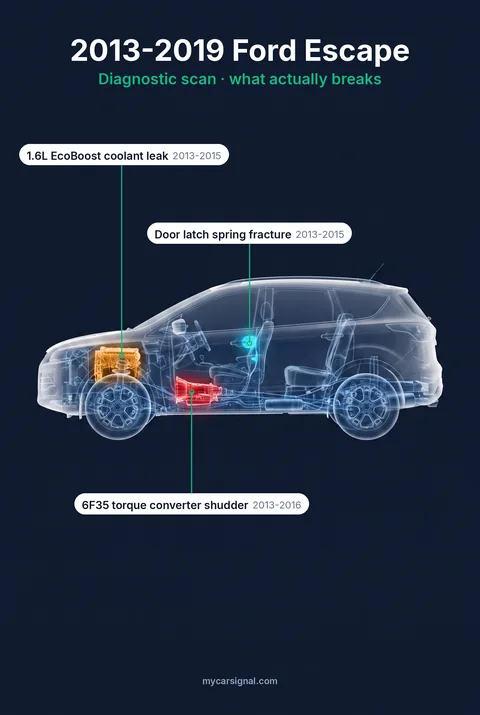
The third-gen Ford Escape sold well in Canada, and plenty are still on the road cheap. But the early ones carry a specific problem you need to understand before you buy: the 1.6L EcoBoost engine has a history of internal coolant leaks that Ford eventually tied to under-hood fire risk. That's not a squeak or a rattle. That's the thing to check first.
The 1.6L EcoBoost coolant leak (2013–2015)
Here's what happens. A cracked cylinder head, cracked block, or a leaking degas bottle hose lets coolant escape onto the hot engine. As it evaporates, it can leave flammable glycol residue behind. Ford's original recall covered 6,146 Escape 1.6 EcoBoosts built between October 2011 and August 2012, then expanded in 2017 to cover certain 2013–2015 Escapes along with the Fiesta ST, Fusion, and Transit Connect running the same engine. Ford's investigation found that a lack of coolant circulation could overheat the engine, crack the cylinder head, and cause a pressurized oil leak on top of the fire risk.
Watch for misfires. Owner and legal reporting flags P0316 and P0302 as the codes most commonly linked to the internal coolant leak. Early on, the fix wasn't even ready. Forum accounts from 2014 describe dealers telling owners to keep bringing the car in for coolant top-ups while Ford worked on a permanent solution, and replacement parts went on backorder because so many cars needed them.
Recall repairs are free at a Ford dealer, so the first move on any 2013–2015 with the 1.6L is to run the VIN and confirm the recall work was done. If you're staring at an out-of-pocket cylinder head job instead, it hurts. RepairPal pegs a Ford Escape cylinder head replacement at roughly $4,181 to $5,020 USD (a general estimate, not Canada-specific). On a cheap early car that repair costs more than the car.
There's a separate, later coolant item worth knowing about too. A Transport Canada recall lists 2013–2019 Escapes for a coolant leak from the engine block heater, which is a different fault from the 1.6L cylinder-head issue. Treat it as its own line item when you check the VIN.
The 6F35 transmission: shudder and harsh shifts
The 6-speed automatic on the early cars, the 6F35, has a reputation for torque converter shudder and harsh or delayed shifts. Owners notice it most in reverse or around 80–90 km/h. One fordescape.org owner with a 2013 2.0L Titanium AWD reported the torque converter failed outright and cost $3,600 USD for a new converter plus a factory valve body. CarComplaints logs a stack of 2016 shudder complaints, many under warranty.
Ford's own paper trail tells the story. TSB 11-11-23 addresses harsh 1-2/2-3 shifts, flare, and delayed engagement, with a fix based on checking fluid level and reflashing the PCM. Then for 2013 Escapes specifically, Ford issued Customer Satisfaction Program 20B27, a goodwill reprogram meant to keep the torque converter from overheating. When a maker quietly reprograms cars out of warranty, it usually means the durability problem was real and widespread. A related driveline bushing and seal issue under bulletin 16-0043 runs about $250 to $370 out of warranty, more if the halfshaft is worn. A full transmission swap with a used unit starts around $1,700.
Door latch recall (2013–2015)
A pawl spring tab inside the side door latch can fracture, which either leaves a door that won't close or, worse, makes you think a door is shut when it isn't. A door popping open while driving is the safety concern. The Escape got swept into a huge multi-model Ford campaign that also hit the Fiesta, Focus, Fusion, C-MAX, Mustang and several Lincolns. Ford later settled a US class action for $5.3 million covering repair reimbursement, with parallel claims reaching the Ontario Superior Court, so this was recognized in Canada too. The recall fix is free through Ford, and Canadian owners who paid before the recall have gotten reimbursed by submitting the receipt and VIN to Ford of Canada.
What it means for price
The early cars look tempting on paper. The 2013 sits at a median $7,474 and the 2015 at $8,999, both with roughly 150,000–180,000 km on them. That's exactly the window where the 1.6L coolant risk and the 6F35 shudder live. A single cylinder-head repair erases the saving over a newer car and then some. The 2018 median of $14,594 and 2019 at $16,968 cost more up front but skip the worst of the early-engine drama and show lower mileage.
| Year | Median price | Median km |
|---|---|---|
| 2013 | $7,474 | 178,298 |
| 2014 | $10,200 | 151,956 |
| 2015 | $8,999 | 152,896 |
| 2016 | $9,995 | 152,549 |
| 2017 | $11,888 | 142,374 |
| 2018 | $14,594 | 116,325 |
| 2019 | $16,968 | 98,685 |
If you want an early car, skip the 1.6L EcoBoost unless the VIN shows the coolant recall completed, or go for the 2.0L or the base 2.5L instead. On any 2013–2016, drive it hard through reverse and 80–90 km/h and feel for shudder or a lazy, jerky 1-2 shift before you sign. Run the VIN through Ford for the door latch and block-heater recalls. And if you're cross-shopping, the 2017–2019 cars carry fewer of the early gremlins and more remaining life in the drivetrain.
What these Ford Escape years cost right now
Live Canadian price benchmarks for every year in this generation:
2013 Escape prices2014 Escape prices2015 Escape prices2016 Escape prices2017 Escape prices2018 Escape prices2019 Escape prices