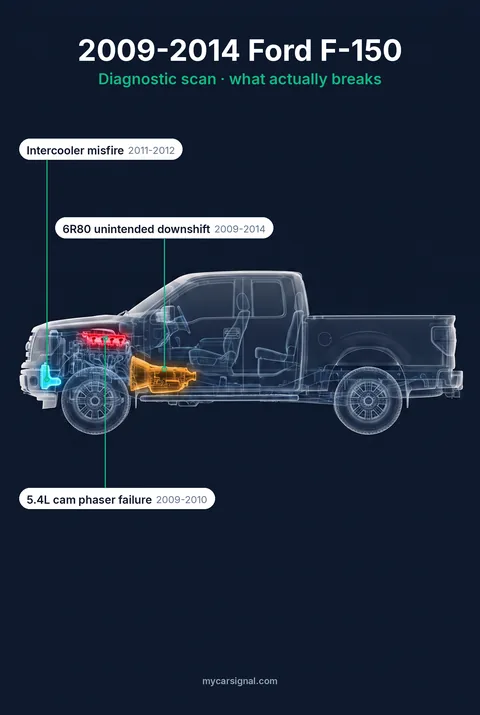
Buy a 12th-gen F-150 and the failure you need to worry about most isn't an engine. It's the 6R80 six-speed automatic dropping a gear on its own. Owners describe the truck slipping into second, or worse into first, without warning while driving. That's not a nuisance rattle. It's a safety problem, and it's the single most documented complaint across this whole generation.
The good news is the era is a genuine turnaround. After the rough 2004-2008 trucks, the 2009 redesign shipped with only about 300 NHTSA complaints and two recalls, an IIHS Top Safety Pick, and a Consumer Reports "Very Good" reliability mark. So most of what breaks here is specific and fixable. You just need to know which engine you're looking at.
The 6R80 transmission: the one to check first
The root cause is usually the transmission output speed sensor losing communication with the powertrain control module, often tied to a failing molded lead frame inside the transmission. When the signal drops, the truck can force a downshift at any speed. On 2011-2013 trucks, owners also report slipping, erratic shifts, and in the worst cases full transmission failure, most of it landing between 80,000 and 120,000 miles (roughly 130,000-190,000 km, right where most of these trucks sit now).
Ford's fix for the unintended downshift is a PCM software reflash, later formalized in bulletin 19S07-S2 in 2019. That's cheap. The expensive version is replacing the internal lead frame rather than just a sensor, and "complete transmission failure" means a rebuild. There's also a known fluid leak at the bulkhead connector sleeve covered by TSB 11-3-25. Before you buy, run the VIN through the Transport Canada recall database. The recall-year boundaries for the downshift campaign aren't clean, so verify by VIN rather than trusting the model year alone.
Engine problems, sorted by which motor you get
This generation gives you four engines, and they don't fail the same way.
| Engine | Years | Main issue |
|---|---|---|
| 5.4L Triton V8 | 2009-2010 | Cam phaser failure (P0011/P0021), rough idle, stalling; spark plugs seizing to the head |
| 3.5L EcoBoost V6 | 2011-2012 | Intercooler condensation causing misfire/power loss on hard acceleration |
| 5.0L Coyote V8 | 2011 | Timing chain tensioner rattle (mainly launch-year trucks) |
| All | 2009-2013 | Coolant leaks at brittle plastic heater core connectors |
The 5.4L V8 in the 2009-2010 trucks is where the cam phaser complaints cluster. A failing phaser throws timing errors, rough idle, and lifter noise, and one forum owner ended up needing a new engine after the cams scored and oil pressure dropped to 10 psi at idle. The same engine has a spark plug problem: the plugs can seize to the cylinder head and snap during removal, and pulling a fragment out sometimes means pulling the head. Ford dealers started recommending 60,000-mile plug changes because of it. Experiences are genuinely split here. Plenty of 5.4L owners cross 250,000 miles with nothing but plugs and a starter, others get bitten hard.
The 3.5L EcoBoost has a narrower, better-understood flaw. On 2011-2012 trucks in humid or damp conditions, condensation collects in the intercooler and causes a stumble or misfire on hard acceleration after a long highway run. NHTSA logged 95 complaints and opened an investigation, then dropped it once Ford's TSB landed. The fix moves an air deflector to the bottom of the intercooler, adds a deflector plate, and reprograms the PCM. It's a cheap dealer job, not an engine teardown.
The 5.0L Coyote, introduced in 2011, is the engine techs and owners praise most, regularly reaching 250,000-300,000 miles with maintenance. The one caveat is early production: 2011 trucks are the ones flagged for timing chain tensioner failure, which starts as an audible rattle and can damage the engine if the chain loses tension. Later Coyotes tightened this up. (The park-outside oil-consumption drama you may have read about is a 2018-2020 issue, not these trucks.)
What to check and which years to prefer
Also worth a look: a bad canister purge or vent valve solenoid can leave the truck stalling or refusing to start right after you fill the tank, and the 2011-2014 5.0L trucks can leak at the quick-connect upper radiator hose fitting.
On price, the market runs from a median of about $8,500 for a 2010 up to roughly $17,000 for a 2014, with the 2013 sitting near $15,247. Mileage barely moves across the years (most trucks are around 190,000 km regardless), so a cheap 2010 is cheap because it's a 5.4L. If that motor needs a phaser job or a seized plug turns into a head removal, the repair can eat the entire saving over a 2013 5.0L. My pick for the generation is a 2012-2014 truck with the 5.0L Coyote and a documented PCM reflash on the transmission. On any of them, confirm the 6R80 recall status by VIN, listen for a timing chain rattle at cold start, and check the firewall heater core connectors for coolant weeping.
What these Ford F-150 years cost right now
Live Canadian price benchmarks for every year in this generation: