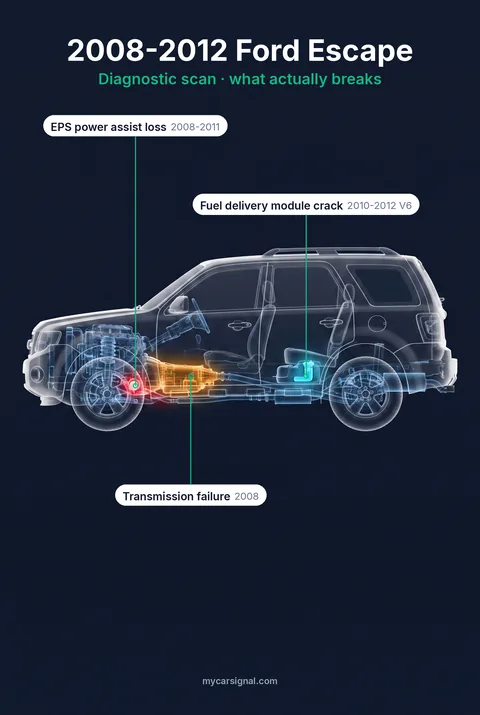
The second-generation Ford Escape earned a reputation as a tough, no-nonsense small SUV, and most of that reputation holds up. The four-cylinder engines are durable, owners love it in the snow, and a well-kept one can run past 200,000 km without drama. But a handful of specific failures come up again and again on the 2008 to 2012 cars, and one of them can cost you $4,000. Here's what actually breaks.
The transmission is the big one
The 2008 Escape used a 4-speed automatic carried over from the first generation. From 2009 on, Ford switched to a 6-speed. The 2008 draws the most transmission complaints of the generation, with owners reporting everything from lurching and hunting for gears to outright failure, typically showing up somewhere in the 130,000 to 190,000 km window. A full rebuild or replacement averages around $4,000, which is real money against a car that isn't worth much more than that.
Worth flagging: sources disagree on exactly which years are worst. Some point at 2006–2009, others call 2010 and later the safe bets. None of that is backed by hard complaint data, so treat "best year" rankings you read online with suspicion. What is well documented is a leaking driver's-side transaxle seal on 2009 through 2012 cars. It drips fluid under the left front, and the fix (seal, sometimes the inner CV joint housing and axle bushing) runs roughly $350 to $620.
Steering, throttle, and a fuel leak recall
Ford recalled 2008–2011 Escapes for a power steering fault. A weak signal from the electric steering torque sensor could stop the control module from reading your input, killing the power assist while you drove. The steering still worked manually through the mechanical linkage, but it went heavy without warning. Transport Canada tracked this one closely and pushed its investigation to Level IV. The fix is a free reprogramming of the power steering module under recall 14S05. If you're looking at one of these years, confirm the recall was done.
Then there's the throttle body. On 2009–2012 cars with the 2.5L four or 3.0L V6, the electronic throttle body could cause stalling in traffic or surging on acceleration, sometimes dropping the car into limp mode. NHTSA looked at about 1.6 million vehicles and closed the case without ordering a recall. Instead Ford ran Customer Satisfaction Program 13N03, extending the throttle body warranty to 10 years or 150,000 miles. So this is a documented pattern, not a safety recall, and owners who paid out of pocket beforehand could claim reimbursement.
The one recall you shouldn't ignore is the Fuel Delivery Module crack on 2010–2012 V6 (3.0L) Escapes. The FDM can crack and leak fuel, which is a fire risk. Recall 16S41 replaces the flange with a redesigned part for free. Note that remedy parts were short at first, so interim notices went out in late 2016 before the actual fix was available.
| Problem | Years | What happens | Fix |
|---|---|---|---|
| Transmission failure/lurching | 2008 (worst) | Hunting, lurching, failure ~130k–190k km | ~$4,000 rebuild |
| Transaxle seal leak | 2009–2012 | Fluid drip under left front | $350–$620 |
| EPS loss of assist | 2008–2011 | Power steering cuts out | Free recall reprogram |
| Throttle body stall/surge | 2009–2012 | Stalling, surging, limp mode | Warranty program 13N03 |
| Fuel Delivery Module crack (V6) | 2010–2012 | Fuel leak, fire risk | Free recall replacement |
The cheap stuff, and the rust
A few smaller issues are common but easy on the wallet. The front ABS tone ring can crack and light up the ABS and traction control warnings; the part is cheap and it's about an hour of labour. The AC blower motor getting stuck on high (seen right across 2005–2012) is usually a failed resistor behind the glovebox, also inexpensive. On 2008–2009 hybrids specifically, the blend door actuator can buzz.
For Canadian buyers, rust matters more than any of that. Owners repeatedly warn about corrosion on the rear quarter panels, the rear wheel well fender edges, and the bottom of the rear hatch. Salt-belt cars take the worst of it. Get underneath one before you buy and check those exact spots, because rust repair can quietly cost more than the mechanical items above.
What's good, and what to buy
Plenty here to like. The Mazda-sourced 2.3L (2008 only) and 2.5L (2009–2012) four-cylinders are proven durable and mostly trouble-free, and the 3.0L V6 is a solid engine aside from some VCT solenoid gripes on 2009 V6s. Owners praise the roomy, practical interior, the winter stability, and the four-cylinder's fuel economy. One forum owner with a 2012 V6 that crossed 76,000 miles with nothing but a hatch seal called it "basically bullet proof."
Prices are low enough that a big repair can swamp the deal. The median 2009 sits at $6,498, the 2010 at $5,250, and the 2011 at $4,750, most of them well past 200,000 km. A $4,000 transmission on a $4,750 car isn't a repair, it's a write-off. So skip the 2008 with its older 4-speed if you can, favour a 2010 or 2011 four-cylinder, and put your money into an inspection: confirm the steering recall was done, drive it long enough to feel for stalling or gear hunting, check for fluid under the left front, and crawl the rear wheel wells and hatch for rust.
What these Ford Escape years cost right now
Live Canadian price benchmarks for every year in this generation: