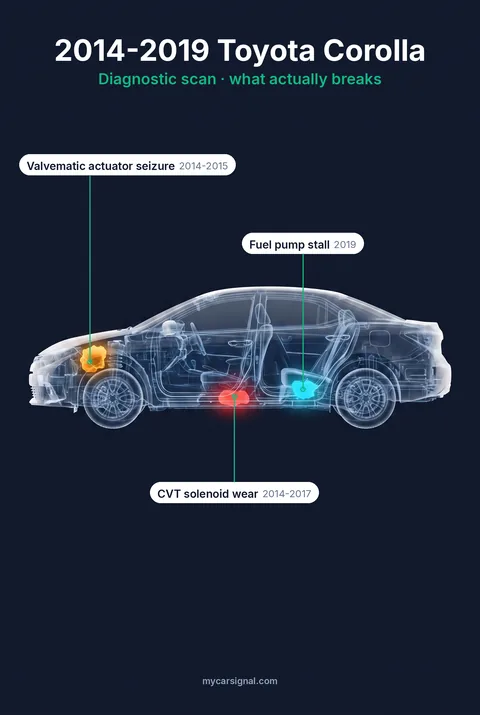
The E170 Corolla earned its reputation. Consumer Reports handed the entire 2014-2019 lineup a 5-out-of-5 reliability verdict, and independent used-car reviewers keep coming back to the same words: bulletproof engine, low maintenance costs, rear drum brakes that seem to last forever. But "reliable overall" and "trouble-free on every build" are not the same thing. This generation has one signature failure that lands hard on early cars, plus a CVT quirk and a cluster of late-cycle recalls you should know before you sign anything.
The Valvematic actuator: the one thing to fear on 2014-2015 cars
Here's the problem that defines the early E170. The 1.8L 2ZR-FAE engine uses a Valvematic actuator, a sealed unit on the end of the cylinder head that controls valve lift. On 2014 and some 2015 sedans, that actuator seizes. When it goes, you get diagnostic code P1046, multiple fault codes, a big drop in power, and sometimes a car that won't start at all.
The most common cause of P1046 is a failure inside the Valvematic controller assembly itself. It's common enough that independent specialists now remanufacture the units. The repair is the ugly part. Toyota's official procedure means pulling the camshaft carrier, timing cover and chains, roughly a 15-hour labour job that lands well past $1,500 to $2,500 at typical shop rates. A well-documented independent shortcut, reaching a coupler pin through the valve cover, cuts it to about 2.5 hours, but not every dealer offers it.
Don't count on warranty here. Toyota issued TSB T-SB-0011-14 for 2014 cars with this engine, but it covers different codes (P2646/P265B) through an ECM software update and explicitly does not touch P1046. So this is not a blanket fix. The good news: a Toyota Master Technician summarizing forum experience pegs the failures to 2014 and some 2015 cars only. Late 2015 into 2016, Toyota ran a quiet engine revision, adding a hydraulic belt tensioner, a spin-on oil filter, an improved PCV system, and a revised Valvematic unit. Cars built after that change, including every Corolla iM, mostly dodge this problem.
The CVT: a software campaign, not a catastrophe
The K313 CVT arrived in most Corollas for 2014, and it comes with two documented issues that get conflated a lot. First, Toyota has a Canadian service campaign for 2014-2017 models where faulty computer programming lets an internal solenoid cycle too much and wear out early. If the wear gets bad, the car drops into limp mode capped at 60 km/h. The fix is a no-charge software update, with valve-body or solenoid replacement if needed. This is a dealer campaign, not a formal Transport Canada recall.
Second, a January 2019 TSB (T-SB-0016-19) documents a high-pitched hiss or whine on 2014-2018 Corolla and 2017-2018 iM cars once the transmission warms up, traced to the valve body plate and fixed by replacing the valve body. Owner sentiment on the CVT is mixed but leans positive with time. One long-time forum member noted in 2021 that after nearly seven years they'd heard of very few actual failures. That said, isolated pain exists: one 2016 owner was quoted $8,000 for a transmission out of warranty and outside the campaign coverage. Real, but not the epidemic CVTs get blamed for generally.
Electrical gremlins, oil use, and the recalls
The 2014 build year also drew complaints for electrical annoyances: faulty door locks, windows, and key fobs, plus infotainment units that some owners paid as much as $3,500 to replace. Like the Valvematic issue, this concentrates in the first year of the redesign. On oil, be careful what you read online. The 2ZR-FAE burns a little oil at high RPM and more as it approaches 100,000 miles, which can foul the catalytic converter if you ignore it. But the famous Toyota oil-consumption warranty program covers older 2AZ-FE engines and pre-2014 Corollas, not the E170. Treat oil use here as a watch-item, not a defect campaign.
The safety recalls are worth a VIN check. An airbag ECU recall spans 2011-2019 Corollas: in certain crashes the control unit could malfunction and fail to deploy airbags or seat-belt pretensioners, fixed by adding a noise filter. Late in the generation, Toyota Canada recalled 54,687 vehicles over a low-pressure fuel pump that could quit abruptly and stall the engine, with some 2019 Corollas affected. There were also a 2014 windshield wiper switch recall (short-circuit risk) and minor tire-pressure and load-label recalls. Consumer Reports counts 5 recalls on the 2019 car versus 2 on the 2014, so the recall load actually grew toward the end of the run.
What to check and which years to prefer
Price does not track risk cleanly here, which matters. The 2014 sits at a median of $12,995 and the 2015 at $12,950, the two cheapest years and the two most exposed to Valvematic failure. A single official-procedure actuator repair can wipe out the savings versus a post-revision car in one shot.
| Year | Median price (CAD) | Key reliability note |
|---|---|---|
| 2014 | $12,995 | Valvematic risk, electrical gremlins, weakest CR year |
| 2015 | $12,950 | Valvematic risk on early builds; revision came late in the year |
| 2016 | $14,740 | Post-revision engine; safer bet |
| 2017 | $16,838 | Last year of the CVT software campaign span |
| 2018 | $17,850 | Fuel pump recall applies; check it's done |
| 2019 | $17,995 | Fuel pump recall, most recalls in the generation |
If you're set on a Corolla from this run, target a 2016 or newer sedan to sidestep the Valvematic issue entirely. Where the 2016 median of $14,740 buys peace of mind the early cars can't. If you do look at a 2014 or 2015, ask specifically whether it's a post-revision engine (spin-on filter is a tell), scan for P1046, and drive it long enough to warm the CVT and listen for whine. On any 2018 or 2019, confirm the fuel pump recall was completed, and run the VIN for the airbag ECU recall across every year.
What these Toyota Corolla years cost right now
Live Canadian price benchmarks for every year in this generation:
2014 Corolla prices2015 Corolla prices2016 Corolla prices2017 Corolla prices2018 Corolla prices2019 Corolla prices