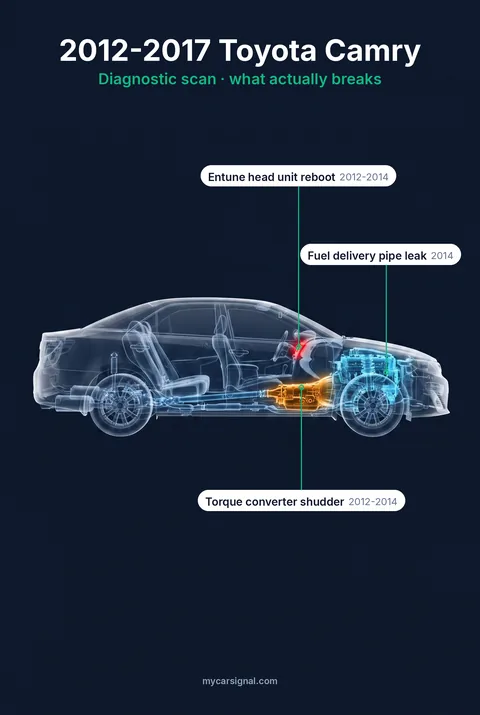
The seventh-generation Camry earned its reputation honestly. Owners describe it as sturdy, comfortable, and cheap to run, with near-bulletproof mechanicals that ask for little beyond oil changes. Reviewers say a well-kept one can clear 250,000 miles. But this generation isn't flawless, and if you're shopping the early years there's one problem you need to understand before you sign anything.
The transmission shudder (2012–2014 four-cylinders)
This is the best-documented fault of the XV50, and Toyota owned up to it. Cars built in 2012, 2013, and 2014 with the four-cylinder engine and the U760 automatic can develop a brief shudder while cruising under light load, roughly between 25 and 50 mph. Toyota's own bulletin, T-SB-0034-14 from April 2014, pins the cause on a faulty torque converter combined with an engine control module software glitch.
The factory fix was a torque converter replacement plus an ECM reflash, done under the powertrain warranty when the cars were new. That warranty is long gone now. Owner forums also report the shudder coming back years after the first repair, and at least one owner had both the ECU and torque converter swapped only to feel it return later. If you're test-driving an early four-cylinder car, hold a steady light throttle around 30 to 45 mph and pay attention to any faint vibration through the floor. It's not a safety issue, but out of warranty it's a real bill.
Good news for buyers who want to skip this entirely: the shudder is bounded to 2012–2014. The 2015 refresh and the 2016 and 2017 cars aren't cited for it.
Entune infotainment failures and oil use
The other 2012–2014 headache is the Entune head unit. When it goes bad it reboots in a loop, stuck cycling the Toyota logo, or the screen freezes or goes black entirely. Bluetooth pairing drops out too. The car still drives fine, but you lose navigation, hands-free calling, and the backup camera display. The same faulty unit turned up in the 2013 Avalon, 2012–2013 RAV4, and 2012–2013 Prius V. Later Camrys with the revised unit aren't cited for the reboot problem.
Oil consumption on the 2.5L four-cylinder (the 2AR-FE) is worth a mention but keep it in perspective. Some owners report burning close to two quarts in under 5,000 miles on higher-mileage cars near 100,000 km. This is anecdotal and forum-sourced, not a confirmed recall or class action for this engine. Don't confuse it with Toyota's famous oil-burning saga, which involved the older 2AZ-FE engine from the previous generation, not the XV50's 2.5L. Still, on any high-km car, check the dipstick and ask the seller how much oil it uses between changes.
Recalls to verify by VIN
Several safety recalls touched this generation. Run the VIN through Transport Canada before buying to confirm the work was done.
| Recall | Model years | Concern |
|---|---|---|
| A/C drain hose | 2012–2013 | Drain hose defect on Camry and Camry Hybrid |
| Fuel delivery pipe leak | 2014 | Fuel may leak in the engine bay, fire risk |
| Front lower control arm | 2014 (16" and 17" wheels) | Left front suspension arm incorrectly manufactured |
| Occupant Classification System | 2016 | Passenger airbag sensing may not calibrate correctly |
Toyota Canada also ran a March 2015 recall covering about 12,043 vehicles across 2015 Camry, Camry Hybrid, and other models. Takata airbag inflator campaigns swept across many Toyota model years in this era too, so confirm both the Takata status and any open recall directly against the VIN.
What owners love, and where the years land
The praise is consistent: strong fuel economy from the four-cylinder, a timing chain instead of a belt so there's no expensive replacement interval, and low running costs overall. The 2017 car, the last of the generation, pulled an 86 out of 100 from J.D. Power for quality and reliability. Complaint volumes drop steadily across the run, from a peak on the 2012 down to the quietest years on the 2016 and 2017. The optional 3.5L V6 with 268 hp is widely liked and just as durable as the four if you want more punch.
On price, the early cars are tempting until you factor in the risk. The median 2012 sits around $11,094, versus about $12,529 for a 2014. But an out-of-warranty torque converter job can eat that whole saving in one visit. The 2015 refresh is the sweet spot for buyers who want the newer look and clear of the shudder years, with a median near $15,000, climbing to about $18,650 for a 2017.
If you want the simplest path, buy a 2015, 2016, or 2017. You dodge the transmission shudder and the Entune reboot loop, and you land on the years with the fewest complaints. If a cheap 2012–2014 four-cylinder is calling, test the light-throttle cruise for shudder, confirm the infotainment boots and pairs cleanly, and check oil level and recall history. A V6 of any year sidesteps the U760 transmission problem too.
What these Toyota Camry years cost right now
Live Canadian price benchmarks for every year in this generation:
2012 Camry prices2013 Camry prices2014 Camry prices2015 Camry prices2016 Camry prices2017 Camry prices