The XV40 Camry earned the same durability reputation as every Camry before it. It also happens to be the generation that dragged Toyota into a federal investigation over unintended acceleration. Both things are true. But if you're shopping one today, the crisis that made headlines matters less than the quiet problem that keeps draining oil out of the four-cylinder engine.
Consumer Reports rates every year of this generation as Recommended, and plenty of these cars are still running past 200,000 km. The Canadian market has examples with 300,000 km still going. That said, this is not a trouble-free car, and which engine sits under the hood decides most of your risk.
The oil consumption problem (both four-cylinders)
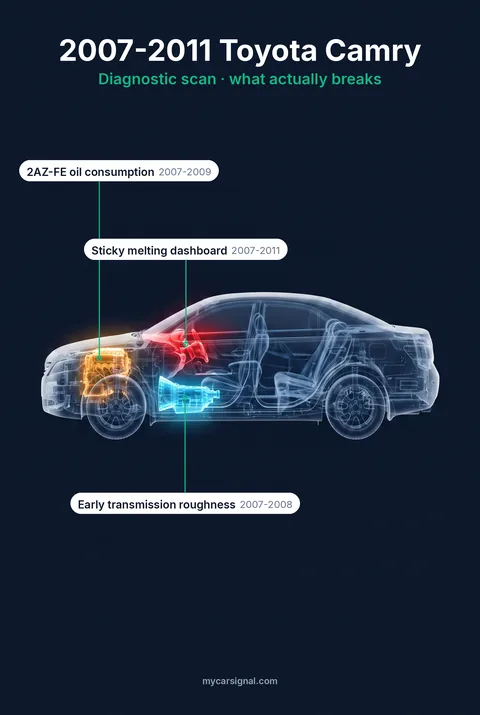
Here's the one that catches buyers off guard. The 2.4L 2AZ-FE four-cylinder in 2007–2009 cars burns oil. Toyota built the pistons and rings with a defect that lets oil blow past and carbonize the rings over time. Once that carbon builds up, the rings stop sealing and the engine starts drinking oil between changes. Owners report the level dropping fast, sometimes smoke from the tailpipe. Ignore it and you can cook the engine.
Toyota never called this a safety recall. It handled the fix through Warranty Enhancement Program ZE7 and a piston redesign under TSB T-SB-0030-15. Both are long expired now, so any repair comes out of your pocket. There's no clean Canadian quote for the job, but a piston and ring replacement is labour-heavy work that runs into the low-thousands and higher depending on how far the shop has to tear down. Many owners just keep a jug of oil in the trunk instead.
Don't assume the later four-cylinder is safe. The 2.5L 2AR-FE that became standard in 2010 has its own separately documented oil-consumption pattern, blamed on thin, low-tension oil control rings that wear early. Some drivers add a quart every 1,000 miles. It tends to show up later and at higher mileage than the 2AZ issue, so a clean-running 2010 or 2011 today can still develop it. Check the dipstick, ask the seller how often they top up, and watch the level over a few weeks if you can.
The V6 is the engine to want
If oil consumption scares you off the four-cylinders, the 3.5L 2GR-FE V6 is the answer. It's one of Toyota's best engines, known for 400,000 km and beyond, and it doesn't share the four-cylinder's ring problem. It also showed up in the Highlander, RAV4 and Lexus RX350, and it topped reliability surveys across all of them past 100,000 miles. A V6 XV40 is the pick for long-term peace of mind.
Sticky dashboards, hard cold shifts, and the recall list
The melting dashboard is the other signature problem across 2007–2011. Heat and humidity break down the dash material until it turns tacky, even sticky and slimy, and in bad cases it produces glare that hurts visibility. One 2010 owner reported the dash melting in high heat while parked. Toyota covered it under enhancement program ZE6 (10 years from first use), but that window has closed for every XV40. Replacement is a serious job because the passenger airbag and most of the interior have to come out. OEM parts are pricey and aftermarket options are mostly cosmetic covers.
Transmissions are a mixed bag by year. A hard, flaring cold-start upshift shows up across the generation and has its own TSB (TC007-07). The early cars are the rough ones. The 2007 model is the worst for transmission complaints, with revving, jerking, slippage and hesitation on downshifts reported at low mileage. The V6 and transmission both settled down as the generation went on.
| Problem | Years affected | Severity |
|---|---|---|
| 2AZ-FE oil consumption | 2007–2009 (+ Hybrid to 2011) | High |
| 2AR-FE oil consumption | 2010–2011 | Medium |
| Sticky/melting dashboard | 2007–2011 | Medium |
| Cold-start hard shifting | 2007–2011 | Low |
| Early transmission roughness | 2007–2008 | Medium |
| Floor mat / sticky pedal recalls | 2007–2010 | High |
On recalls, this is the generation everyone remembers. The floor-mat pedal entrapment recall grew into a 3.8-million-vehicle action covering 2007–2010 Camrys, and a separate sticking accelerator pedal recall hit the same years. The joint NASA/NHTSA study found no electronic cause. The only real culprits were badly installed floor mats and mechanically sticky pedals. There's also a 2010-only 4-cylinder recall for a power-steering hose that could rub through a rear brake tube and leak fluid, plus a power window master switch fire-risk recall on some 2007 and 2009 cars. Confirm all of these were done by VIN before you buy.
What to buy
The cheap early cars carry the most risk. The 2007 median sits at $6,451 and the 2009 at $7,000, but a piston-and-ring repair on a 2AZ oil-burner can wipe out that saving in a single visit. The 2010 commands the top of the range at $8,749, and it's the year most sources point to for fewer complaints, with the lowest median mileage of the four. Just remember its 2.5L engine has its own oil habit, so "better" means fewer problems, not none. The 2011 at $7,899 also posted the generation's best initial-quality score.
Simplest advice: chase a V6 if you can find one, and it dodges the whole oil-consumption question. If you're set on a four-cylinder, favour a 2010 or 2011, pull the dipstick, and factor a dashboard replacement into your offer on any car that's already gone sticky. Verify the pedal and floor-mat recalls are closed, and don't let a $6,000 sticker on a 2007 tempt you past a soft engine.
What these Toyota Camry years cost right now
Live Canadian price benchmarks for every year in this generation:
2007 Camry prices2009 Camry prices2010 Camry prices2011 Camry prices