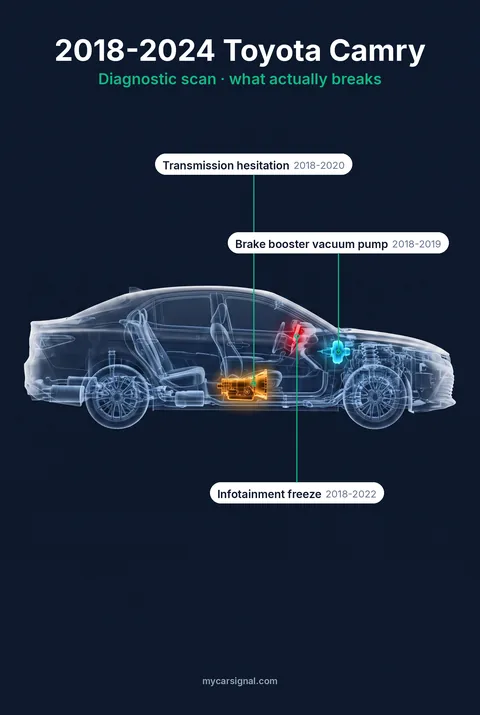
The 8th-gen Camry earns its reputation. RepairPal puts it at 4.0 out of 5.0 for reliability, third out of 24 midsize cars, with an average annual repair cost of $388 USD. Owners bring it in for unscheduled repairs about 0.3 times a year, right in line with the class. But no car is trouble-free, and this one has a short list of documented weak spots worth knowing before you buy.
The transmission hesitation on 2018-2020 cars
The most talked-about complaint on early XV70 cars is a hesitation when you accelerate from a slow roll or a rolling stop. Toyota acknowledged it with an official service bulletin. The exact wording in the bulletin asks whether the car "exhibits hesitation on acceleration from a slow roll or rolling stop." The fix is a software reflash of the ECM/PCM, done under warranty at no cost to the owner.
The bulletin originally covered 2018-2019 cars with the A25A 4-cylinder engine, then got extended to 2020 models. Owner forums report V6 cars showing similar gear-hunting behavior that the reflash campaign didn't target, but that claim comes from a single forum poster, not a Toyota document, so treat it as anecdotal. If you're test-driving an early 4-cylinder car, ask the dealer whether the calibration update has been applied. It's free, so there's no reason it shouldn't be.
Separately, some 2018-2020 cars with the UA80/UB80 transmission can leak fluid from the transmission side cover. Toyota's bulletin described this as under investigation at the time it was issued. There's also a high-mileage note worth filing away: around 125,000 miles, some owners report shift-quality degradation that's usually resolved with a shift solenoid replacement or a throttle position sensor adjustment, not a full rebuild. Plenty of these cars are past 120,000 km on the Canadian market already.
The panoramic sunroof is the real weak point
If the transmission thing got fixed with software, the sunroof didn't. This is the one XV70 problem that runs the entire generation. The failure is in the factory track and plastic components, which crack or shift so the glass binds, pops, jams, or won't close. A 2023 lawsuit collected real owner complaints: a 2018 XSE in for service five times over rattling and not closing, a 2019 needing a full panel replacement, a 2021 XSE stuck open, a 2022 XSE serviced three times. That spread of model years tells you it was never quietly fixed mid-generation.
Cost is the sting here. Dealers quote sunroof track or glass replacement in the thousands of dollars. Some owners get Toyota to cover it under warranty case by case, others pay out of pocket. On a cheap early car, a sunroof repair can wipe out most of what you saved by buying old. The 2018 median sits at $21,490 and the 2019 at $22,300, so a four-figure sunroof bill is a serious dent. The simplest defense: buy a Camry without the panoramic roof if you can, and if you can't, cycle it fully open and closed several times during the test drive and listen for binding or rattling.
Paint, screens, and sensors
Paint peeling and clear-coat failure show up on Blizzard Pearl (070) and Super White (040) cars, mostly 2018-2019 within this generation. It's color-specific, not a generation-wide problem. Toyota ran a customer support program covering nearly 2 million vehicles across models, available to original and used owners. It isn't a recall, though, so coverage has been inconsistent dealer to dealer. If you're eyeing a white 2018 or 2019, inspect the roof, hood, and trunk edges closely for lifting clear coat.
Infotainment freezing and blank screens have drawn owner complaints from 2018 through 2022 and beyond. The screen randomly freezes and stays unresponsive until you cycle the ignition. Firmware updates address many cases. This escalated into a 2025 recall covering roughly 591,000 Toyota and Lexus vehicles, including Camry, over the 12.3-inch display failing to activate at startup or shutting off while driving. The exact Camry model years in that recall weren't clear in the reporting, so confirm coverage against Toyota Canada's lookup for the specific car you're considering. An illuminated check-engine light from a failing oxygen sensor is also a common owner-reported fault across the years, usually cured by replacing the sensor.
Recalls to check by VIN
A handful of recalls hit specific years. Cross-check any car against Toyota Canada's recall lookup before you buy, since these are the safety items.
| Recall | Years | Issue |
|---|---|---|
| Brake booster vacuum pump | 2018-2019 | Vane cap can break, causing sudden loss of braking assist |
| Low-pressure fuel pump | 2018 | In-tank fuel pump may fail |
| Engine ECU software (rear O2 monitoring) | 2018 | Special Service Campaign K0A, ECU reprogram |
| Occupant Classification System | 2020-2022 | OCS sensor short can stop the front passenger airbag deploying |
| Seat head restraint welding | 2023-2024 | Insufficiently welded head restraint brackets, second row |
One more anecdotal note on hybrids: a 2020 Camry Hybrid owner reported the 12V battery dying at 36,400 miles and four years old, which cascaded into false Pre-Collision and parking brake faults. Replacement ran $185 USD aftermarket or $250 USD for the OEM part from the dealer. That's a single detailed report, not a pattern, but the 12V battery on hybrids is cheap to rule out.
What owners get right, and what to buy
The praise is consistent. The 2.5L 4-cylinder has the lowest complaint density of the five engine options and is the reliability pick. Owners routinely take these cars past 200,000 miles when they're maintained, and forum consensus singles out the panoramic roof as the only true problem. Many owners run 5,000-mile oil changes rather than Toyota's 10,000-mile interval, which is owner opinion, not a factory spec, but it's a cheap habit. J.D. Power gave the 2023 Camry a "great" 84/100 reliability score.
For the best balance, a 2.5L 4-cylinder from 2021 or later dodges the concentrated 2018-2019 TSB cluster and the paint program years, and the newer cars carry lower mileage. The 2021 median is $26,227 at around 94,900 km, and the 2022 runs $29,995 at about 79,400 km. If you want an early car for the price, that's fine, just confirm the transmission reflash was done, skip the panoramic roof, and check white paint hard. Test the touchscreen for freezes, run the sunroof through its full cycle, and pull the VIN through Toyota Canada's recall lookup before you sign anything.
What these Toyota Camry years cost right now
Live Canadian price benchmarks for every year in this generation:
2018 Camry prices2019 Camry prices2020 Camry prices2021 Camry prices2022 Camry prices2023 Camry prices2024 Camry prices