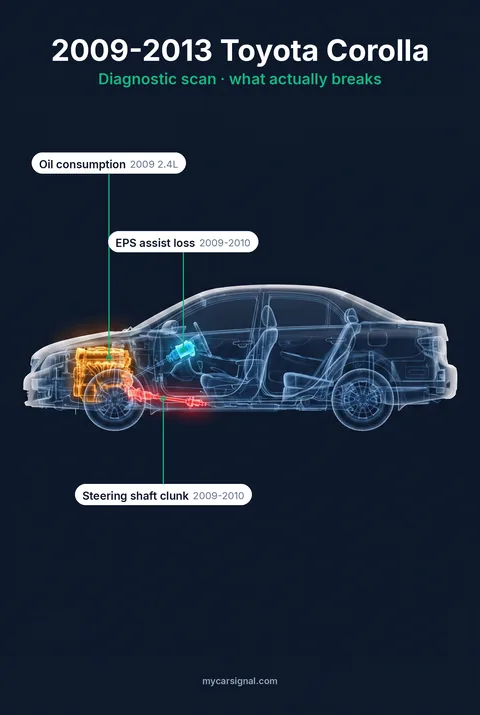
The tenth-generation Corolla earned its bulletproof reputation, but not every year in the run deserves it equally. The 2009 car is the one that trips buyers up. It collected the most complaints of any year in this generation, and a handful of those complaints point to expensive engine work. Get the year and engine right and you're buying one of the most durable compact cars ever sold. Get them wrong and you could be staring at a four-figure engine bill.
Oil consumption: the big one, and it depends on the engine
The headline problem is excessive oil consumption. CarComplaints logged 23 oil-burning reports against the 2009 Corolla, and the average repair ran about $4,570 USD at roughly 100,750 miles because the fix was often a complete rebuild. The cause is defective piston rings, and the same defect turns up across several Toyota and Scion models from that era that share the 2.4L engine family.
Here's where it gets murky. CarComplaints organizes its data by model year, not engine size, so the 2009 tally lumps every trim together. Corolla forum owners who dug into the mechanicals say the oil burning belongs to the XRS trim's 2.4L 2AZ-FE engine, not the base 1.8L 2ZR-FE. Their read: the 1.8L never had the ring problem. Toyota eventually replaced the 2AZ with the 2.5L 2AR specifically because of the burning issue. I'd treat those $4,000-plus figures as skewed toward XRS cars, but the sources don't fully settle it, so check any car you're serious about. Watch the dipstick and look for blue smoke at cold startup.
The good news: owners say the piston-ring defect was sorted starting with the 2010 model. Consumer Reports backs the timeline, rating the 2009 Corolla "average" for reliability and the 2010 through 2013 cars "above average."
Steering complaints, mostly 2009 and 2010
Steering is the second recurring theme, and it comes in two flavors. The first is a clunk or pop from the column. Toyota acknowledged it in TSB-0243-09 for 2009-2010 Corolla and Matrix cars, with the fix being a new steering intermediate shaft. The second is more unsettling: owners of 2009-2010 cars reported the car wandering at highway speeds, needing constant tiny corrections. NHTSA got roughly 150 reports of the electric power steering assist cutting out at speed, and about 1,690 total problems were filed against the 2010 model, with steering among the worst categories.
NHTSA opened a formal investigation (PE10-008) into the wandering complaints and closed it in 2011 without ordering a recall, concluding the system worked as designed. A narrower recall did land in November 2012 covering some 2009 cars for the steering intermediate extension shaft, which could cause noise and reduced steering response. One thing worth knowing: sudden heavy steering that clears after a restart can come from a weak battery or alternator, not the EPS itself.
| Year | What stands out |
|---|---|
| 2009 | Worst year for complaints. Oil consumption (2.4L XRS vs 1.8L disputed), steering wander, minor electrical, poor paint. |
| 2010 | Still high complaint count. Steering TSB applies. Paint peeling reported by ~56,000 miles. |
| 2011-2013 | Oil issue resolved, CR rating "above average." Later airbag ECU recall (2011+) is a crash-electronics matter, not wear. |
Recalls, paint, and the smaller stuff
Takata airbag inflator recalls hit these cars in several waves, covering 2003-2013 Corolla among a long list of Toyota, Lexus and Scion models. A separate 2020 recall covered 2011-2019 Corolla for an airbag control unit that could fail to deploy in a crash, so that one only touches the back half of this generation. Confirm any car you buy has had its Takata work done. A couple of other recalls (aftermarket seat heaters, occupant-sensing calibration) only apply to dealer-installed accessories, not stock cars.
Paint quality is a real gripe, worse on the 2010 than the 2009, with peeling and bubbling reported by around 56,000 miles. Transmissions get mentioned less but do show up: one pattern has the gearbox failing near 135,000 miles or the synchronizer needing work around 85,000. On a test drive, every shift should feel smooth. Buying a 2.4L car? Look for coolant seeping from the head gasket area at the back of the engine and walk away if you find it. A P0138 check-engine code usually just means a bad rear oxygen sensor, which is a cheap fix.
What to buy
Prefer 2011 through 2013 with the base 1.8L. That combination sidesteps the oil-burning trim, lands you in the "above average" reliability window, and dodges the worst of the steering and paint complaints. The 2ZR 1.8L has proven itself across millions of cars and even found its way into the Lotus Elise. It's the engine you want.
The price data reinforces the advice. The median 2012 sits at $9,770 and the 2013 at $10,995 in the Canadian market, versus $7,690 for a 2009. That's roughly a $2,000 to $3,000 premium for the newer cars. If an XRS oil-consumption problem forces a rebuild, that repair alone dwarfs the money you saved buying the cheaper early car. Spend the extra up front. On any car, check the dipstick, watch for cold-start smoke, feel the steering at highway speed, and confirm the Takata airbag has been replaced.
What these Toyota Corolla years cost right now
Live Canadian price benchmarks for every year in this generation:
2010 Corolla prices2011 Corolla prices2012 Corolla prices2013 Corolla prices