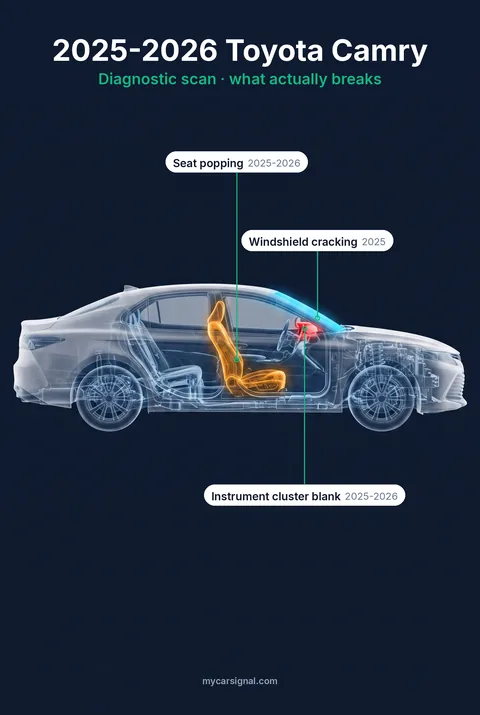
The 9th-gen Camry, code-named XV80, arrived for 2025 as a hybrid-only redesign. It's too new for real long-term dependability data. What we do have: three safety recalls, a stack of owner complaints, and one loud, unresolved gripe about the front seats. Here's what's actually breaking on the car so far.
The seat that pops
This is the complaint owners keep coming back to. The driver's seat back and lumbar area pops, cracks, and shifts, described by one owner as "like a soda bottle being crushed." It shows up during acceleration and braking, and owners find it distracting enough to worry about safety. It's been reported on both driver and passenger seats across SE, XSE, LE, and XLE trims on 2025 and 2026 cars.
The frustrating part is the fix. Dealers have tried stuffing seats with padding and lubricating the frame. One owner said the repair lasted about a month before it was "popping like crazy" again. Another had a TSB done and it held for five days. There is a TSB (T-SB-0021-24 Rev2) covering a collapsed front seat outer back bolster, with a seat back edge protector as the remedy. But owners report that bulletin doesn't reliably kill the popping. Toyota has not issued a public recall for the lumbar complaint specifically, so right now this is a warranty roulette. Test-drive the exact car, shift your weight around, and listen.
Blank screens and a bolt in the inverter
Two recalls matter most here. The big one covers the 7-inch instrument cluster going blank at startup, which can also silently kill your turn signals, hazards, and warning chimes. It hits the LE, SE, and Nightshade trims with the smaller display. Roughly 508,000 cars in the U.S. and about 11,159 in Canada. Toyota's fix is a software update, delivered over the air where possible. One owner's dealer just unplugged the battery as a stopgap before the official remedy.
The second recall is newer and, as of this research, still had no finished fix. On 2025-2026 Camry Hybrids, a bolt inside the inverter may not have been tightened right. That can drop the car into reduced power or cut power to the wheels, and a loose bolt can short and cause a fire. Transport Canada lists 2,411 affected cars in Canada. Toyota logged 34 technical reports and 15 warranty claims before pulling the trigger. The dealer will tighten or replace the inverter assembly. If you're buying a hybrid, confirm this one has been done.
A third recall is narrow: second-row center seatbelts damaged during manufacturing, limited to early production from October to mid-December 2024. Cars built after that window are clear.
| Problem | Years | Fix |
|---|---|---|
| Seat popping / lumbar instability | 2025-2026 | No confirmed permanent fix |
| Instrument cluster blank at startup | 2025-2026 (LE/SE/Nightshade) | Software update (recall) |
| Hybrid inverter loose bolt | 2025-2026 Hybrid | Inspect/tighten or replace inverter (recall) |
| Second-row center seatbelt | Early production 2025 only | Recall repair |
| Windshield cracking | 2025 | Glass replacement |
Screens, glass, and other early gremlins
The center touchscreen has its own problems separate from the cluster recall. Owners report it randomly going blank, freezing, or rebooting, sometimes while the backup camera is up. Consumer Reports flagged infotainment as a weak spot, and one owner said wireless Android Auto failed to connect roughly 80% of the time. At least one dealer called it a factory issue but couldn't give a timeline.
Then there's the glass. Spontaneous windshield cracking is the single most-filed complaint category with NHTSA for the 2025 Camry. One owner's windshield cracked 10 days after purchase while parked in a garage overnight. Another described a long crack running from the top middle across the glass with no impact. Worth noting: an older windshield class-action investigation exists for 2019-2021 Toyotas, but the XV80 cracks are a fresh, separate cluster. Moonroof leaks and vibration noise have also come up.
What owners actually love
Fuel economy is the headline. Real-world numbers land in the 43-55 mpg range, with one SE owner averaging 43 city and up to 55 on the highway. The FWD LE is rated highest at 51 combined; the XSE AWD trades down to about 44 for foul-weather traction. Ride quality and quietness draw steady praise, and the sportier XSE gets called the best-handling Camry yet, though its brake pedal feels heavy and numb. The Camry also topped its segment in J.D. Power's 2024 Initial Quality Study, and Consumer Reports rates the 2025 as more reliable than the average car of its year.
Buying advice
Every XV80 is a hybrid, so there's no engine to seek out or avoid. FWD or AWD makes no documented reliability difference. Pricing is tight between the two years on the Canadian market: the median 2025 sits at $39,594 with about 44,000 km, while the 2026 runs $39,997 with far lower mileage around 10,000 km. That's a rounding error apart, so buy on condition and recall status, not model year. Before you sign: confirm both open recalls (cluster software and inverter bolt) have been completed, sit in the seat and load it up to feel for the pop, cycle the touchscreen and phone mirroring, and check the windshield closely. The 2026 is a near-carryover, so you're not missing a fixed year by choosing 2025.
What these Toyota Camry years cost right now
Live Canadian price benchmarks for every year in this generation: