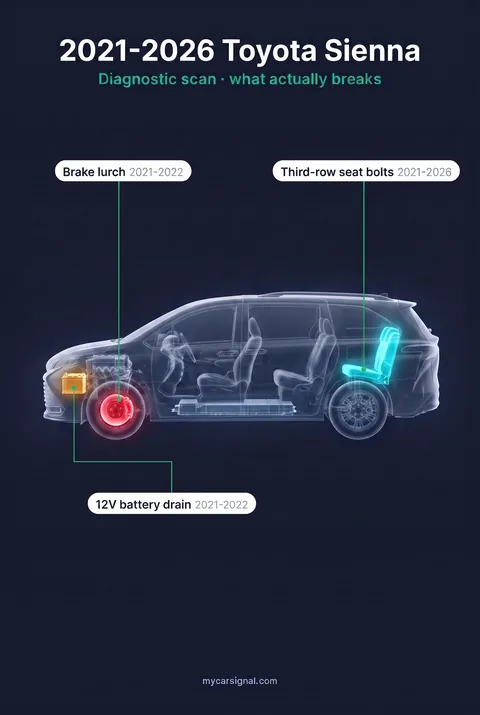
The fourth-gen Sienna went all-hybrid in 2021, and by most accounts the hybrid drivetrain is the least of your worries. That's the good news. The trouble shows up in three specific places: the brakes, the 12V battery, and the seats. None of it points to a fragile van. But if you're shopping the early years, you want to know exactly what to check before you sign.
One analysis of 631 owner complaints across the 2021–2025 model years found the heaviest concentrations sit in the interior and the brakes, not the powertrain. For a vehicle families buy to keep for a decade, that's the pattern you want. The engine and hybrid system stay out of the top failure categories. The rest of the van is where the money and the annoyance live.
The brake lurch on 2021 and 2022 vans
This is the most safety-significant issue and the best documented. Owners describe braking gently toward a stop, usually downhill or in stop-and-go traffic, when the van momentarily fails to slow or lightly surges forward before the brakes catch. You end up stabbing the pedal harder to actually stop. The cause is a glitch in the handoff between the hybrid's regenerative braking and the mechanical friction brakes.
Complaint volume is concentrated in 2021 and 2022. Toyota put out a February 2021 bulletin about "abnormal brake feel" and a longer-than-usual pedal stroke, but attorneys who reviewed it noted that bulletin didn't cover the regen-to-friction transition itself. The real fix came later: T-SB-0047-24, a software update for the brake module issued in May 2024, describing the exact lurch symptom. It's covered under the 3-year/36,000 km warranty. The catch is that most 2021 owners are already out of that window. One owner reported a dealer charging 250 USD to diagnose plus 300 USD for the software reset once the warranty had lapsed. Test-drive any 2021 or 2022 van in stop-and-go conditions and ask the seller whether the May 2024 update was applied.
Dead 12V battery on early hybrids
The second well-documented problem is a 12V auxiliary battery that goes flat unexpectedly, sometimes leaving owners stranded and waiting for a tow. Toyota's own bulletin T-SB-0016-21, from March 2021, is scoped to the 2021 Sienna HV and explains that the Hybrid Vehicle ECU doesn't go to sleep after a jump-start, a battery disconnect, or a new battery install, so it keeps draining the 12V while the van sits.
It didn't fully die with the fix. A 2022 XSE owner in Canada had it diagnosed by Toyota Canada as the DCM module continuing to draw power after shutdown, and noted Toyota thought they'd corrected it for 2022 but hadn't. Some owners resorted to pulling the DCM fuse, which kills SOS and the Bluetooth speaker functions, rather than a permanent dealer repair. If you're looking at a 2021 or 2022, ask whether it's had unexplained no-start events.
The seat and seatbelt recalls
Seats and seatbelts are the biggest recall cluster in this generation, and they span the whole run. Here's what's on file with NHTSA and Transport Canada.
| Recall | Years affected | Problem |
|---|---|---|
| Third-row seatback bolts (25V-086) | Practically all 4th-gen, Oct 2020 production onward (~168,000 units) | Improperly torqued bolts; seatback may not hold in a crash, a real concern with kids in the third row |
| Second-row seatbelt (21V-889) | 2022, 8-passenger config (~2,300 units) | Webbing could bunch at the shoulder anchor and tear in a crash; dealer replaces the belt assemblies |
| Second-row seat rail welds (25V-668) | 2025 Sienna Hybrid (7,142 units in Canada) | Rails may not have been welded properly; Toyota advised not carrying second-row passengers until repaired |
| OCS airbag sensor (23TB15) | 2021 Sienna Hybrid (part of a broad campaign) | Short circuit could stop the front passenger airbag from deploying; dealer inspects or replaces the sensor |
The third-row bolt recall matters most because it covers essentially the entire generation. Run the VIN through Toyota's recall lookup before you buy any of these vans and confirm the work was done. Lower down the severity scale, owners report interior rattles, a second-row bench that won't slide because the release cable doesn't pull the actuator far enough, thin paint that shows every scuff, and the odd TPMS or fuel-gauge quirk. Annoying, mostly warranty stuff, not deal-breakers.
Which years to prefer
2023 looks like the sweet spot. It sits after the brake and battery issues peaked, and at time of capture no NHTSA recalls were on file for that model year. Consumer Reports rated the 2021 as less reliable than other cars from the same year, then rated the 2024 as more reliable than its peers, which lines up with a genuine improvement trend. Keep in mind the 2025 introduced two new seat recalls, so newer didn't mean cleaner across the board.
On the Canadian market, the 2021 median sits at $42,999 against about 106,000 km, while the 2023 runs $50,722 at 77,000 km and the 2024 is $54,995 at 45,000 km. The gap between a 2021 and a 2023 is real money, but the 2021 is also the one carrying the brake lurch, the battery drain, and the airbag sensor recall. If you go with an early van, budget for the brake software work in case it wasn't done, and treat the recall lookup as non-negotiable. The single hybrid powertrain is the same across every year and it's the part nobody complains about, so there's no engine choice to agonize over. Buy on service history and recall status instead.
What these Toyota Sienna years cost right now
Live Canadian price benchmarks for every year in this generation:
2021 Sienna prices2022 Sienna prices2023 Sienna prices2024 Sienna prices2025 Sienna prices2026 Sienna prices