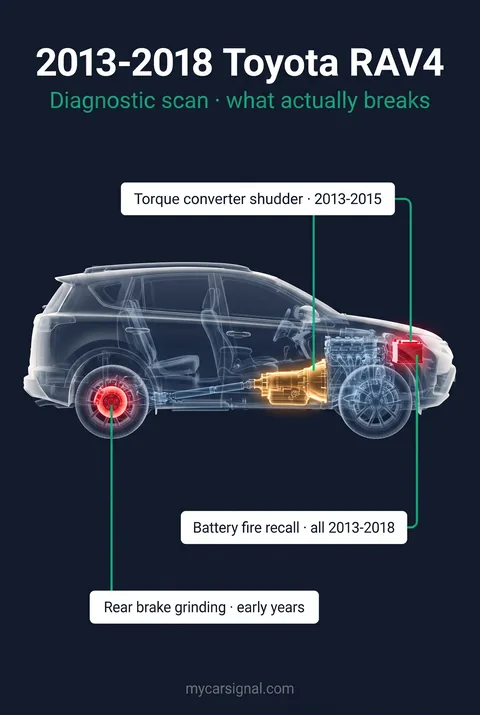
The fourth-gen RAV4 (the XA40) earned Toyota's usual reputation for going the distance, and the numbers back that up. But this generation carries one real mechanical headache on the early cars, plus a fire-risk recall that hit every model year retroactively. Here's what actually breaks, which years to lean toward, and where a bad repair can eat your savings on a cheap example.
The torque converter shudder (2013–2015)
This is the defining issue for the early XA40. Toyota's own warranty bulletin describes a brief, intermittent shudder during torque converter lock-up, felt under light throttle between roughly 25 and 50 mph. Owners say it feels like briefly hitting a rumble strip, and it tends to get worse as the miles pile on.
Toyota acknowledged it and set up a Warranty Enhancement Program (ZH1) covering 2013–2015 model years, extending torque converter coverage to 8 years or 150,000 miles. Here's the catch. That program was a customer support measure, not a formal recall, and it had an expiration. Anyone shopping these cars now is almost certainly past the window. Owners report Toyota declining the repair once the program lapsed, even when the shudder first showed up while coverage was still technically active.
Dealer quotes for a torque converter replacement ran around $4,000 to $4,500 (figures reported in USD from U.S. owners and shops). On a 2013 or 2014 RAV4, that repair can cost as much as the car. One owner even reported the vehicle towed in with an outright transmission failure after the shudder went ignored, though that's a single anecdote, not a documented pattern. Test drive any 2013–2015 car specifically in that 25–50 mph band under light throttle and feel for it.
Rear brake grinding and a few smaller items
The same early years (2013–2015) get a second documented gripe: a grinding noise from the rear wheels at low speed when you brake. Toyota traced it to corrosion building up on the rear rotors during an overnight soak and issued TSB 0037-15 with a fix. A related front-end squeak has been pinned on faulty rotors and pads. Watch out here, because some dealers wave off the grinding as "normal" metal-to-metal contact before they'll do the TSB work, so buyers hit repeat visits.
Oil consumption deserves a quick correction. The infamous Toyota oil-burner reputation belongs to the older 2.4L 2AZ-FE engine used through 2008, not the XA40's 2.5L 2AR-FE. The newer engine is a fresh design with dual VVT-i and is widely seen as a step up. A handful of high-mileage 2AR-FE owners still report meaningful oil use, with catch cans and a step-up viscosity as home fixes, but it's a minor, mileage-dependent thing here, not a defining flaw.
The recall you can't age out of
The biggest recall for this generation is recent, not a launch-era problem. In 2023, Transport Canada flagged a fire risk across all 2013–2018 RAV4s. A total of 249,416 were recalled in Canada. The issue: the battery hold-down may not properly secure certain aftermarket 12V batteries, letting the battery shift so the positive post can touch the hold-down bracket and short out. The fix replaces the battery clamp sub-assembly, tray, and positive terminal cover. It matters most if a previous owner had the battery swapped at a non-Toyota shop. Confirm the recall work was done before you buy.
Two things buyers often assume but don't apply here. The Takata airbag recall hit the 2004–2005 RAV4, not the XA40. The melting/sticky dashboard defect is an early-2000s problem too. Neither shows up for 2013–2018 in the sources checked.
| Issue | Years affected | Severity |
|---|---|---|
| Torque converter shudder | 2013–2015 | High |
| Rear brake rotor grinding (TSB 0037-15) | 2013–2015 | Low |
| Battery hold-down fire risk (2023 recall) | 2013–2018 | High |
| High-mileage oil consumption (2.5L) | 2013–2018 | Low |
Which years to buy
Complaint volume tells a clear story. The launch cars logged the most: 134 for 2013 and 120 for 2014 in the CarComplaints database, dropping to 77 for 2015. The 2016 refresh year fell to 43, right when the torque converter and brake TSBs stopped applying, which suggests the underlying parts were revised. The 2017 count ticked back up to 78 for reasons the research didn't pin down, and 2018 came in lowest at 38.
That maps neatly onto price. The 2013 sits at a median of $13,999, and the 2015 lands at $15,490 despite a steep 209,594 km median. Those are the cheapest cars, and they're exactly the ones carrying the shudder risk with no factory coverage left. A $4,000-plus torque converter job erases that saving in one visit. Step up to the refreshed 2016 at $18,517 or the 2018 at $23,888 (median 103,666 km) and you sidestep the two big early-year TSBs entirely.
If you do go early to save money, test drive in the shudder speed range, listen for rear-brake grinding, and get the 2023 battery recall confirmed as completed. On any year, the 2.5L engine is the one to seek out over pre-2009 cars. The hybrid arrived for 2016, but dedicated reliability data on that powertrain was thin in the research, so buy one on its own merits rather than assuming it mirrors the gas car.
What these Toyota RAV4 years cost right now
Live Canadian price benchmarks for every year in this generation:
2013 RAV4 prices2014 RAV4 prices2015 RAV4 prices2016 RAV4 prices2017 RAV4 prices2018 RAV4 prices