The third-gen RAV4 has a reputation for going the distance, and a lot of them do. But this generation carries a handful of specific, well-documented weak spots. Some got covered by Toyota warranty programs that have since closed. That timing matters more than the price on the windshield, so start here.
The rear differential on AWD models
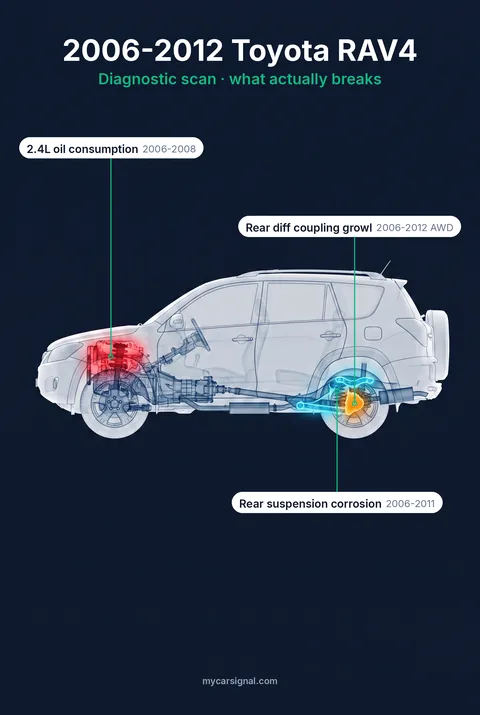
If you're looking at an all-wheel-drive RAV4 from 2006 through 2012, the rear differential is the first thing to check. Owners report a growl from the rear coupling, sometimes on low-mileage cars soon after purchase. Both rear seals are also prone to leaking, and a clogged breather plug lets pressure build until fluid pushes past the seals.
Toyota ran two coverage programs here. One replaced the rear differential coupling free of charge under the 5-year/60,000-mile powertrain warranty. A separate campaign (owners call it ZF4) covered a defective bearing on 2006–2012 AWD models. Here's the catch: that bearing program expired April 30, 2017, or nine years from first use, whichever came first. Every one of these cars is now past that window. If the diff needs work today, you're paying for it, and owners describe seal repairs running into the hundreds of dollars at a dealer.
Engine: skip the early 2.4L, chase the 2009+ 2.5L
The 2006–2008 four-cylinder cars use the 2.4L 2AZ-FE, and it burns oil. Toyota acknowledged this with a warranty enhancement program (ZE7) tied to defective piston rings. The frustrating part for owners was the runaround before the extension existed, with some dealers calling the consumption "normal." The process, once covered, involved an oil-consumption test and a repair if the engine failed it.
Then 2009 fixed it. That model year brought the 2.5L 2AR-FE four-cylinder, which one independent reviewer called one of the most reliable engines on the market. If you want a four-cylinder XA30, buy 2009 or newer and you sidestep the oil-burning problem entirely. The optional 3.5L 2GR-FE V6 is also a strong engine, shown to hit 250,000 miles in Camry and Highlander duty. It has one real caveat, covered below.
The rear suspension arm recall, times three
This is the one to take seriously. The rear suspension arms (rear tie rods) on 2006–2011 RAV4s could rust and fail because adjusting lock nuts were improperly tightened after service, damaging the threads. A failed arm means a sudden alignment change and possible loss of control. NHTSA logged at least nine crashes and three injuries tied to it.
Toyota's first recall in August 2012 didn't hold. Toyota itself admitted the earlier repair was "not adequate" and that parts of the procedure may not have been done correctly. The final 2016 recall made dealers replace the rear lower suspension arms and seal them in epoxy to lock the alignment permanently. Around 329,000 US RAV4s fell under that campaign. Note the year range: 2012 was left out, which points to Toyota fixing the component for the last model year. Confirm the recall work was actually completed on any 2006–2011 car you're considering.
Water pumps, coils, and the rest
Water pump leaks show up across both engines, concentrated in the 2006–2008 cars. On a four-cylinder the pump runs roughly $320 to $580; on the V6 it can top $1,000. The bigger danger is on high-mileage V6 trucks, where a pump that fails unnoticed can overheat the engine and warp the cylinder heads, a repair worth more than an old RAV4. The blunt advice from buyers: never buy a V6 over 100,000 miles without service records showing the water pump, or budget to replace it.
Ignition coils fail often enough to cause misfires and shaking; replace the spark plugs at the same time. The steering intermediate shaft wears too, around $320 to $480, with the occasional full rack replacement costing more. Early cars also throw EVAP and fuel-system codes, so check the gas cap before chasing bigger parts.
Two safety recalls apply beyond the suspension one. The Power Window Master Switch on 2006–2011 cars could short and melt from inconsistent grease, a fire risk. And on 2006–2012 cars, the rear outboard seat belts could be cut by the seat cushion frame in a frontal crash; the fix installs a protector over the frame. Both were free remedies, so verify they were done.
| Problem | Years | Notes |
|---|---|---|
| Rear diff coupling / seal leak (AWD) | 2006–2012 | Warranty programs now expired |
| 2.4L oil consumption | 2006–2008 | Gone with 2009 engine change |
| Rear suspension arm corrosion | 2006–2011 | Recalled 3 times, final fix 2016 |
| Water pump leak | 2006–2008 (both engines) | V6 overheat risk at high km |
| Power window switch fire risk | 2006–2011 | Safety recall |
| Rear seat belt cut hazard | 2006–2012 | Safety recall |
What to buy, what to check
The generation earns its rep in the later years. Consumer Reports rated 2008, 2011, and 2012 more reliable than the average car of their year, while 2006 was the weak debut. On the Canadian market a 2010 sits around a median of $12,990 with about 191,000 km, and a 2012 runs near $11,297 at similar mileage. The prices are close enough that reaching for a cleaner later car makes sense, and a single V6 water pump or out-of-warranty rear diff repair erases whatever you'd save on a rougher early one.
Best picks: a 2009–2012 four-cylinder for the good 2AR-FE engine, or a well-documented V6 under 100,000 miles. On any 2006–2011 car, get proof the rear suspension recall was completed. On any AWD car, listen for a rear-end growl and check the diff for leaks, because that bill is now yours. And on early four-cylinders, watch the dipstick between changes.
What these Toyota RAV4 years cost right now
Live Canadian price benchmarks for every year in this generation: