The 11th-gen Accord is young. It landed for 2023 and there are only three model years on the road, so nobody has 150,000 km of hard data on these cars yet. What we do have is a stack of recall filings from Transport Canada and NHTSA, a run of dealer service bulletins, and enough owner complaints to see where the early cars stumbled. Most of it is electrical and software teething. Some of it is worth taking seriously before you sign.
Start with the recalls, because two of them touch safety directly and one is so recent that most affected cars still haven't been fixed.
The recalls you actually need to check
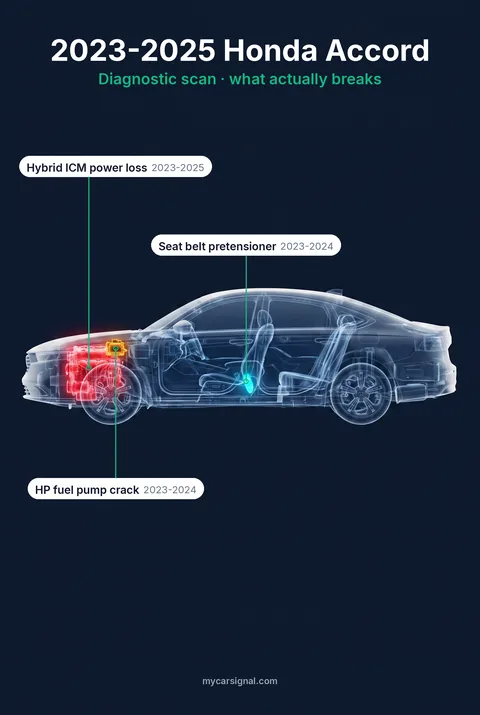
The high-pressure fuel pump is the big one. Honda found improperly manufactured pumps on 2023-2024 Accord and Accord Hybrid cars that can crack and leak fuel, which Transport Canada spells out plainly as a fire risk. Honda Canada recalled roughly 61,000 vehicles for this. The fix is a free inspection and pump replacement. It started as a 2023-only stop-sale in December 2023, then got widened to 2024 cars about a year later, so don't assume a 2024 is clear of it.
Then there's the Integrated Control Module software flaw on the 2023-2025 Accord Hybrid. Under certain conditions the module resets while you're driving and you lose power to the wheels. About 6,632 cars are affected in Canada. The catch is timing: notices only went out to owners around January 2026, meaning a large share of hybrids on the used market right now have not had the update applied. This lines up with a nasty pattern in the NHTSA complaint logs, where owners describe the car dropping from 100 km/h to a crawl with "Power Train Failure" and the emergency braking kicking in. If you're shopping a used Accord Hybrid, confirm this fix is done before you drive it home.
Two more are quick to verify. A seat belt pretensioner on some 2023-2024 cars is missing a rivet, so it may not fire properly in a crash. And a driver's seat cushion frame that wasn't torqued down correctly can leave the seat unsecured. That seat recall kept expanding, with more letters expected as late as March 2026. All of these are free fixes. Run the VIN through Honda Canada before you buy and check that every open recall is closed.
Software gremlins, plastic lines, and the 1.5T question
Beyond the recalls, the most common owner gripe is the infotainment. Blank screens, frozen touchscreens, and CarPlay dropping out show up repeatedly on 2023 cars. Most get sorted with a software reset or update at the dealer, though a few needed a new head unit. There's also a documented parasitic 12V battery drain traced to the telematics control unit failing to finish its setup, which leaves owners with a dead battery.
One design complaint is specific to this generation and worth a look. The gas, brake, and EVAP lines are plastic and there's roughly a 14-inch stretch where they sit exposed to road debris without a shield. One owner reported a road strike that nearly severed a line and led to a bill over $7,000 USD at the dealer. That's a low-probability event, but the exposure is real, so it's worth a glance underneath if you can get the car on a hoist.
The 1.5T turbo four carries a shadow from the previous generation. A 2022 class-action alleged an oil-dilution defect in the 1.5T across 2018-2022 Accords, 2019-2023 CR-Vs, and 2019-2022 Civics, with worst-case outcomes running to head gasket failure. Head gasket work on this engine family isn't cheap. RepairPal pegs it at $2,230 to $2,864 USD, and one Ottawa owner of a 2017 CR-V with the same engine got quoted $8,700 CAD. Here's the honest read: those failures are on older 10th-gen engines, and there's no confirmed evidence yet that the 11th-gen 1.5T shares the problem. There's also no proof it doesn't. Owners on the forums are openly watching to see what happens once these cars pass 80,000 km. Until then it's an open risk, not a verdict.
What owners actually love, and how to buy
The praise is nearly unanimous on one thing: the hybrid. The two-motor system (204 hp, 247 lb-ft) is smooth and efficient, and owners routinely clear 40 mpg without effort, with reviewers citing a combined 48 mpg. Consumer Reports predicts the 2023, 2024, and 2025 Accord will all be more reliable than the average new car. A typical 2023 Touring owner put it simply: perfect car, over 40 mpg, wouldn't buy anything else.
Complaint volume is dropping year over year, which fits the picture of early electrical bugs getting ironed out. A 2023 hybrid runs about $29,997 on the Canadian market against $33,574 for a 2024 and $40,894 for a 2025. The 2023 is the value pick, but it's also the car most exposed to the fuel pump, seat belt, and ICM recalls, so the saving only holds if those fixes are already done.
| Problem | Years | Severity | Fix |
|---|---|---|---|
| High-pressure fuel pump crack/leak | 2023-2024 | High | Free recall (inspect/replace) |
| Hybrid ICM reset / power loss | 2023-2025 Hybrid | High | Free recall (software) |
| Seat belt pretensioner missing rivet | 2023-2024 | High | Free recall |
| Driver's seat cushion frame loose | 2023-2024 | Medium | Free recall |
| Infotainment freeze / CarPlay drop | 2023 | Low | Software update |
| 1.5T oil dilution (carryover concern) | Unconfirmed on 11th-gen | Medium | Watch, unresolved |
My advice: buy the hybrid if you can, run the VIN through Honda Canada, and refuse any hybrid where the ICM recall isn't closed. If you're set on a 1.5T, keep an eye on oil level between changes and know the head gasket history on this engine family. Get the underbody looked at for those exposed plastic lines. Do that and the Accord is exactly the low-drama sedan its reputation promises.
What these Honda Accord years cost right now
Live Canadian price benchmarks for every year in this generation: