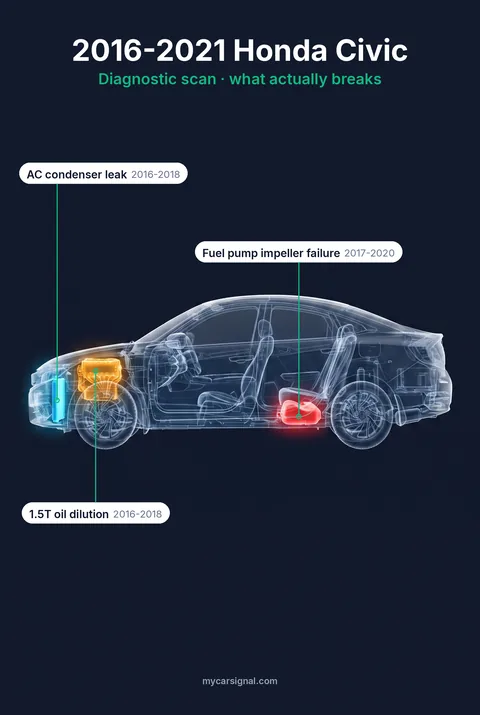
The 10th-gen Honda Civic is a genuinely good used car. It's also carrying a few specific problems that show up again and again, and one of them lives inside the engine most buyers actually want. If you're shopping a 2016 through 2021 Civic, the year and the engine matter more than the trim or the mileage. Here's what breaks.
The 1.5L turbo and oil dilution
This is the headline problem. The 1.5-litre turbo (the L15B7, direct-injection) lets gasoline seep past the injection system and into the engine oil. The oil level rises, the viscosity thins out, and you get a strong fuel smell in and around the car. Owners have reported hard cold starts and worries about stalling. Honda first framed it as a cold-weather thing, but Consumer Reports collected complaints from owners in California, Texas, and other warm states, so the cold-only story doesn't hold up.
It hits 2016 through 2018 cars hardest. Honda's fix on those years was a software recalibration plus a free oil change, handled as a product update and an extended warranty rather than a safety recall (Honda's position is that it isn't a safety defect). Owner-forum consensus, credible but not confirmed by Honda, says the software only reduced the problem on 2016–2018 and that a physical hardware change on the 2019 and later cars actually addressed it. There was also a class-action investigation covering 2016, 2017, and 2018 Civic and CR-V owners. One owner summed up the dealer visit: "Oil change is included free as part of the update. The only thing that they may make you pay for is the oil filter."
The practical read: if you want a 1.5T, lean toward 2019 or newer. On a 2016–2018 turbo, confirm the software update was done and check the oil for signs of dilution and fuel smell. A lot of owners just prefer the 2.0L naturally-aspirated engine here. It's the simpler design with less to go wrong, and the long-term durability reputation reflects that. That's owner opinion, not a lab study, but it's a consistent one.
The fuel pump recall is the serious one
This is the issue that can leave you stranded. Denso fuel pumps built with low-density plastic impellers absorb fuel, warp, and bind, which can make the car suddenly stall, sputter, or shut off while driving. It's a real safety recall, and the repair is free. NHTSA campaign 21V-215 (an expansion of the earlier 20V-314) covers 2019–2020 Civic Hatchback, Coupe, Sedan, and Type R. Honda Canada's related campaign is bigger: roughly 297,836 2017–2020 Acura and Honda vehicles recalled for free fuel-pump replacement.
Because this came in more than one wave as new VINs were flagged, don't assume a given car is clear. Run the VIN through Honda Canada's recall lookup and confirm the pump was replaced. This is the one item on the list I'd treat as non-negotiable before buying.
AC condenser, screens, and the smaller stuff
The air-conditioning condenser is a common failure. Tiny holes open in the tube walls, the refrigerant leaks out, and the AC stops cooling. What made this worse early on: dealers often blamed rock chips and road debris and denied warranty coverage. Honda Canada eventually fixed that with a 10-year, unlimited-kilometre warranty extension for condenser leaks caused by a materials defect. It started with 2016–2018 Civics and was later expanded. Inside that window the repair costs you nothing, so check whether a car's already had the condenser replaced or is still eligible.
The Display Audio infotainment is the other recurring gripe. Owners report the screen going black and flashing, freezing, unresponsive touch, and radio lock-ups. One described the display flashing black to gray for two minutes before sorting itself out. CarComplaints singled out the 2016 model year, but even the flagship FK8 Type R gets criticized for a slow, crash-prone system that owners compare to a cheap old Android tablet. So this is a platform-wide software problem, not just the base cars.
Two more, both softer evidence. Clutch wear on the manual and Si cars gets a scary forum reputation, but the actual testimony is mixed to positive: stock clutches lasting 95,000 to 137,000 km, including hard use, with slippage mostly tied to aftermarket tunes rather than stock cars. And clear-coat chipping around the gas door and front grille comes up a lot, with dealer paint-warranty coverage described as inconsistent. Neither is a documented factory defect the way the fuel pump is.
Recalls worth confirming by VIN
| Issue | Years | Notes |
|---|---|---|
| Fuel pump (Denso impeller) | 2017–2020 (CA campaign); 2019–2020 per NHTSA | Safety recall, free repair. Can cause stalling. |
| Aluminum wheels | 2017–2020 | Wheel nuts can loosen, wheel can detach. Free inspection/replacement. |
| Piston wrist-pin circlip | 2016 (2.0L, built Sept 2015–Feb 2016) | Missing/loose circlip can damage the cylinder. |
| VSA / electric parking brake | 2016 Sedan & Coupe | Parking brake may not engage right after ignition-off. |
| AC condenser | 2016–2018+ (extension expanded) | 10-yr unlimited-km warranty extension for leaks. $0 in window. |
| Oil dilution | 2016–2018 (1.5T) | Product update, not a safety recall. Software + free oil change. |
What this means for what you pay
The price ladder rewards patience. A 2016 sits at a median of $13,970, and a 2018 at $16,989, but the cheapest early cars are also the ones exposed to oil dilution and the 2016-specific recalls. Step up to a 2019 at $18,498 and you're into the model year that reportedly got the hardware fix for oil dilution, though you're now inside the fuel-pump recall range, so confirm that pump was done. The 2020 ($20,950) and 2021 ($21,995) carry lower median mileage and the fewest open questions.
If you're set on a 1.5T, 2019 or newer is the safer bet. If you'd rather not think about any of it, the 2.0L is the engine owners trust for the long haul. Whatever the year, do three things before you sign: run the VIN for the fuel-pump and wheel recalls, check the oil dip on a turbo car for fuel smell and an over-full reading, and confirm the AC condenser history while the warranty extension can still work in your favour.
What these Honda Civic years cost right now
Live Canadian price benchmarks for every year in this generation:
2016 Civic prices2017 Civic prices2018 Civic prices2019 Civic prices2020 Civic prices2021 Civic prices