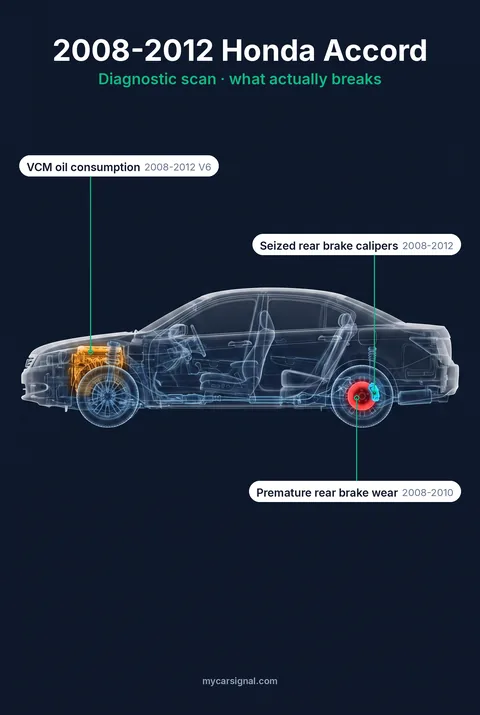
The 8th-gen Accord earned its reputation honestly. Reviewers who list all its flaws still call it reliable, and the aggregate scores back that up. But two problems separate a good used Accord from a money pit, and both track closely to which engine you pick and which model year you're looking at.
Here's the short version. Buy the four-cylinder, favour 2011 or 2012, and budget for rear brakes if you land on an early car. Now the detail.
The V6 oil-burning problem is the big one
Honda gave the 3.5L V6 a cylinder deactivation system called Variable Cylinder Management (VCM-2). Under light load, the computer shuts down some cylinders to save fuel. The software had bugs. VCM cycled on and off repeatedly, which burned oil and fouled the spark plugs, and a fouled plug means misfires. There's a mechanical root cause too: deposits build up on the oil control rings, the rings stick, and oil seeps past into the combustion chambers.
Honda issued two fixes. TSB #11-033 is a software update that stops the on-off cycling (it targets trouble codes P3400 and P3497). TSB #12-087 goes further and replaces the pistons and rings on affected engines. In the US, a class-action settlement (Soto v. Honda) covered 2008-2012 Accords with the 6-cylinder VCM-2 engine, alleging Honda built more than 1.5 million cars that burned oil excessively. Honda extended the powertrain warranty on those cars to eight years with no mileage cap and reimbursed out-of-pocket repairs.
What matters for a Canadian buyer: this defect runs the entire 2008-2012 V6 production. It isn't fixed by a later model year, because the same VCM-2 hardware and software were used throughout. The only remedies are the retrofit software update and, eventually, a piston and ring job. That last repair is a big one. US-focused estimators put a piston-ring replacement at roughly $1,800 to $3,500, mostly labour. There is a separate Canadian settlement, but it's labelled an "oil dilution" condition and extends the warranty to six years with no mileage limit. Oil dilution and VCM oil consumption aren't obviously the same defect, so don't assume the US eight-year coverage applies here.
Early rear brakes wear out fast
The other well-documented complaint hits 2008, 2009, and to a lesser extent 2010 cars. Rear brake pads that should last around 70,000 miles were wearing out in 15,000 to 24,000 miles. NHTSA logged hundreds of complaints. Dealer techs blamed the setup: the rear brakes were too small for the load the Electronic Brake Distribution system put on them, the calipers dragged, and the pad friction material was too soft.
Honda dealers called it normal wear, so it wasn't covered, and a rear pad replacement ran about $200 to $250 (USD). Whether Honda ever formally fixed it is genuinely unclear. One report says Honda adjusted the EBD system on 2008-2009 cars so afflicted examples should have the update by now. Another says Honda never issued a TSB for it at all. Sources disagree, so treat it as unresolved and check the rear brakes yourself.
Brake trouble doesn't stop there. Across the whole generation, rear calipers can seize or leak past 100,000 km-plus, and even 2011-2012 cars aren't immune. On high-mileage Accords generally, plan for the usual wear parts: alternator, starter motor, crankshaft position sensor, and blower motor.
| Problem | Years | Notes |
|---|---|---|
| VCM oil consumption / misfire | 2008-2012 V6 | Software TSB, then piston/ring job (~$1,800-3,500 USD) |
| Premature rear brake wear | 2008-2010 | Pads gone by 15k-24k mi; ~$200-250 USD to replace |
| Seized/leaking rear calipers | 2008-2012 (100k+ mi) | Persists across generation |
| Clear coat / paint peeling | 2008-2012 (worst 2008) | Bumper, door handles, trunk, rear spoiler |
Recalls, paint, and the seats nobody warned you about
There's a real recall history here, most of it airbag-related. Honda recalled 303,904 2008-2009 Accord sedans because side-impact sensors were too sensitive and could deploy the side airbags when a door was slammed shut. In Canada, Transport Canada recall 2012031 covered 2012 Accords whose side curtain airbag inflators might not deploy in a crash. Then came the Takata-era frontal passenger inflator campaigns, which swept in 2003-2012 Accords over several years. Consumer Reports counts nine NHTSA recalls against the 2008 model year alone. Verify the airbag recalls are closed before you buy.
Two softer issues show up constantly. Clear coat peels, especially on 2008 cars, on the front bumper, door handles, trunk, and rear spoiler, and by the time it shows the 3-year paint warranty is long gone. And the seats. Owners across all five years report back pain and leg circulation problems after 15-20 minutes of driving. You won't catch it on a short test drive, so sit in the thing for half an hour.
What holds up, and which years to buy
The four-cylinder K24 is the engine to seek out. Owners routinely report crossing 200,000 miles on it with nothing but regular maintenance. It sidesteps the entire VCM oil saga because it doesn't have VCM. That alone makes the four-cylinder the safer used buy. The V6's six-speed automatic draws occasional complaints about clunky shifts and slipping, mostly on cars that skipped proper transmission fluid changes.
The complaint data lines up neatly with model year. CarComplaints logged 2,496 complaints against the 2008, then 988 for 2009, 507 for 2010, 205 for 2011, and 242 for 2012. That's a steep drop after the first two years. Aggregated reliability scores call 2011 and 2012 the strongest of the generation. Consumer Reports is harsher on the 2008 specifically, rating it below average for its year, which fits the brake and VCM issues clustered in early production. So the sources disagree on the 2008, but they agree on the direction: newer is safer.
The prices reward the same logic. On the Canadian market the median 2008 sits at $4,999 with about 236,000 km on it, while the 2012 runs $10,198 at a much lower 149,000 km. The gap looks big until you price a piston-ring job or a round of rear brakes on the cheap early car. A high-mileage 2008 V6 that needs the VCM repair can erase its entire price advantage in one shop visit.
If you want the least risk: a 2011 or 2012 four-cylinder. Pull the dipstick and check for low oil on any V6. Look for peeling clear coat on the bumper and spoiler. Ask when the rear brakes were last done. And sit in the driver's seat long enough to know whether your back can live with it.
What these Honda Accord years cost right now
Live Canadian price benchmarks for every year in this generation:
2008 Accord prices2009 Accord prices2010 Accord prices2011 Accord prices2012 Accord prices