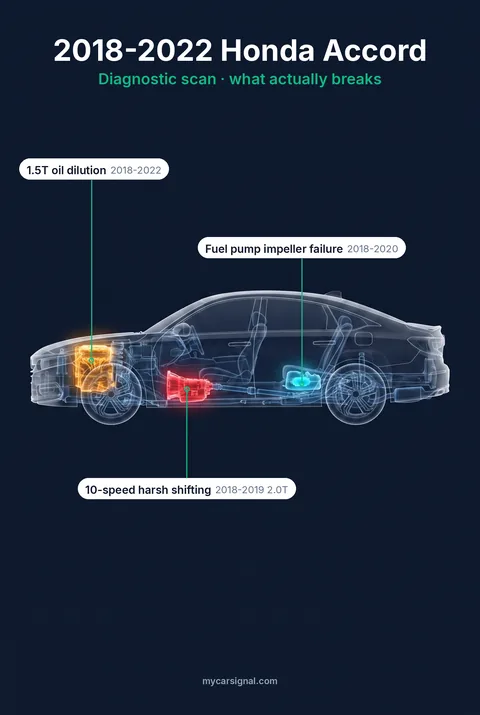
The 10th-gen Accord is one of the better used midsize sedans you can buy right now. It's roomy, the controls make sense, and Consumer Reports still calls it a solid used pick. But the record isn't spotless, and where it isn't, the engine you choose matters more than the model year. Here's what actually breaks.
The 1.5T turbo and oil dilution
The base engine is a 1.5L turbo (the L15B7), the same family that gave Civic and CR-V owners the well-known oil dilution headache. Gasoline seeps past the rings during cold-start cycles and mixes into the engine oil. In cold climates like most of Canada, owners report the classic signs: a fuel smell off the dipstick, oil that looks thin or milky, an oil level that climbs instead of drops, rough idle, and sometimes a check-engine light.
One thing to be straight about. Honda's official warranty extension and the Honda Canada class-action settlement for this problem named only the 2016–2018 Civic and 2017–2018 CR-V. The Accord isn't listed in the higher-authority reporting on that remedy, even though it shares the engine and Canadian owners describe the same pattern. A lower-quality aggregator claims TSB 19-039 covers the Accord too, but that conflicts with the settlement scope. So if you buy a 1.5T Accord expecting the same free remedy Civic owners got, don't count on it. Honda did push an ECU software update after the 2018 model year that adjusts cold-start behavior to reduce dilution, which is why 2019-and-later 1.5T cars are generally seen as the safer bet.
The 10-speed automatic and early electrical gremlins
The 2.0T models use a 10-speed automatic, and the early builds had a rough start. A transmission repair shop puts it plainly: the 2018–2019 10-speeds shift harshly because of software calibration. Owners describe jerky, clunky shifts at low RPM and in stop-and-go traffic. The good news is that most of these were sorted with a dealer reflash or valve body service, and later-generation cars behave better.
The early years also had a 12V battery that liked to die. A US law firm opened an investigation into premature battery failure on 2017–2018 Accords, with owners finding a drained battery even when the car sat untouched. The suspected culprits are a parasitic draw tied to the stability assist system, a faulty A/C relay, or the wrong battery charge management mode. Then there's the infotainment. Unresponsive or frozen touchscreens turn up across the generation, and in at least one case the dealer only fixed it by swapping the whole audio module. Some units also show bubbling or delamination under the screen, which is a manufacturing defect, not a software bug.
The disputed one: head gaskets
You'll find scary blog posts about head gasket failures on the 1.5T, including a 2020 Accord that failed at 49,000 miles. Take them with salt. Long-time Accord forum moderators say they've never seen a confirmed 10th-gen head gasket failure reported, and there's no NHTSA complaint volume backing it as systemic. It's real for a handful of owners, but it's not a generation-wide defect. Treat it as rare rather than expected.
Recalls you must check by VIN
| Recall | Years affected | What it does |
|---|---|---|
| Fuel pump (impeller) | 2018–2020 Accord, 2017–2020 Hybrid | Low-density impeller can cause no-start or stalling while driving. Dealer replaces the pump module free. |
| Body Control Module software | 2018–2020 Accord and Accord Hybrid, plus 2019–2020 Insight | ~737,000 vehicles. BCM programming flaw tied to unexpected electrical behavior. Free software update. |
The fuel pump recall is the important one. It was reissued and expanded more than once, including a 2023 NHTSA filing, which tells you the first fix didn't fully take for some cars. Don't assume a used Accord is clear just because it's a few years old. Run the VIN through the recall lookup before you buy, and again after, because these campaigns keep moving. The BCM recall names 2018–2020 outright, so it isn't a one-year fluke.
What owners actually like
The praise is consistent, and it points you toward the right car. The 2.0T is the engine forum owners trust: one multi-year owner with a 2020 2.0T says they still love it after four and a half years, and the general consensus calls it more dependable than the 1.5T, gas mileage aside. The Accord Hybrid also gets flagged as a more reliable powertrain by owners who've run both. Consumer Reports singles out the EX trim as the sweet spot for equipment, though it rated the 2018 as only about average for reliability, and secondary summaries mark 2018 and 2019 as the weakest years of the run.
What to buy and what to check
If you want the calmest ownership experience, look at a 2.0T or a Hybrid from 2020 or later, and confirm both recalls were completed. A clean 2020 sits around $23,998 with roughly 102,000 km, which buys you past the worst of the 2018–2019 electrical and shift complaints. The 2018 median of $19,990 is tempting, but that's the year with the harsh-shift 10-speed, the battery-drain investigation, and the pre-update 1.5T. If you do chase a cheap early 1.5T, pull the dipstick cold and smell it for fuel, check the oil level against the marks, and verify the ECU update was applied. Later cars climb steadily: 2021 runs about $26,500 and 2022 about $28,990, both with under 84,000 km. On a test drive, work the touchscreen hard, watch for clunky low-speed shifts, and factor a possible audio module or oil-change-interval habit into your math on any 1.5T.
What these Honda Accord years cost right now
Live Canadian price benchmarks for every year in this generation:
2018 Accord prices2019 Accord prices2020 Accord prices2021 Accord prices2022 Accord prices