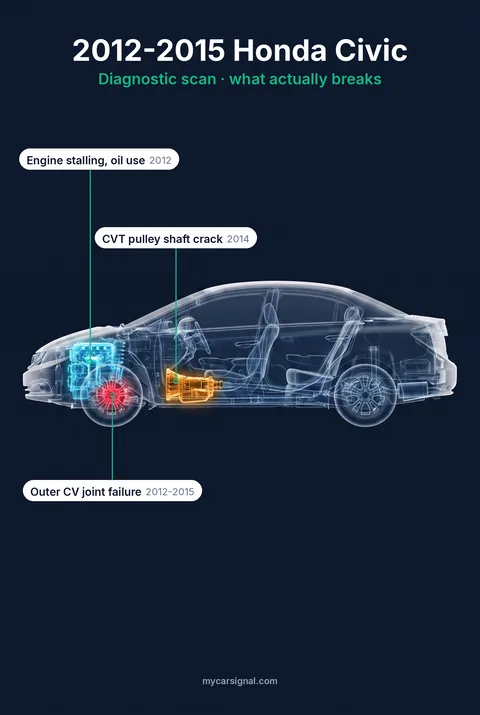
The 9th-gen Civic has a reputation for going the distance, and mostly it earns it. The engines are tough, the running costs are low, and complaint volume for these years actually sits below what the 2016-and-later cars racked up. But the generation carries a few specific headaches, and which ones you face depends heavily on the year you buy. A 2012 is a different animal from a 2014. Here's what breaks and what to check before you hand over cash.
The paint problem nobody warns you about
This is the single most repeated complaint across the whole 2012-2015 run. Owners report the clear coat clouding, flaking, and peeling, usually starting near the windshield pillars and the rear window, then creeping across panels over a few years. One 2012 owner described "HUGE cloudy bald spots" on the roof with crackling clear coat almost everywhere else. Forum threads single out silver and white 2013-2015 cars as the worst offenders, though that's owner pattern-matching, not a confirmed engineering root cause.
Honda clearly knew something was off. Owners note the paint warranty got stretched to six or seven years, which doesn't happen for a car that's fine. There's a widely repeated claim of US and Canadian class actions over the defect, but treat that as owner talk until you see a court docket. Repainting is done panel by panel, and one body shop quoted around $600 for a single panel (currency unconfirmed, so read it as a ballpark). On a cheap early car, a full repaint can swallow the entire price advantage of buying a 2012 over a 2014. Inspect the roof, pillars, and hood in daylight before you commit.
The CVT: a 2014-2015 story only
Here's the split that matters most. The 2012 and 2013 cars use a conventional 5-speed automatic. The CVT arrived in 2014, and it brought a documented defect with it. Honda recalled roughly 143,676 vehicles (2014 Civic built January to November 2014, plus the 2015 Fit) under NHTSA campaign 15V574000, mirrored by Transport Canada. The software controlling the transmission could over-stress the drive pulley shaft, and some shafts were made at the soft end of the hardness spec. A stressed shaft could crack, which risks losing propulsion or, worse, the front wheels locking up while driving. The fix was a free software update that started rolling out in October 2015.
The software patch didn't quiet everyone down. Owners kept reporting shudder and vibration when accelerating from a stop around 30 to 40 mph on 2015 cars, worse in stop-and-go traffic. NHTSA logged a 2015 transmission failure that needed a full replacement, and another owner's transmission gave out near 75,000 miles with the dealer refusing to cover it under the campaign. These are individual complaints, not a validated failure rate. Still, on a CVT car you want proof the recall software was applied, and any shudder on the test drive is a red flag worth a lot of money down the road.
Recalls, mostly clustered on the 2012
The earliest cars carry the most safety recalls. Check the VIN against Transport Canada's database for any of these.
| Issue | Years affected | What happens |
|---|---|---|
| CVT drive pulley shaft (software) | 2014 (Jan-Nov build) | Shaft can crack; loss of propulsion or front wheel lock-up |
| Steering column tilt bracket | 2012 (Oct 26-30 build) | Column may not absorb crash impact as designed |
| Driveshaft retaining clip | Early 2012 | Driver-side driveshaft can separate |
| Side curtain airbag inflator | 2012 | One or both airbags may not deploy |
| Fuel line O-ring leak | Narrow window (1,000+ units) | Misaligned O-ring allows small fuel leak |
| Tire bead damage in assembly | 2014 LX | Bead tear risks rapid air loss |
A note on the Takata scare: the 9th-gen Civic does not show up on the major Takata airbag lists. Those cover 2003-2011 Civics, which are the older 8th generation and earlier. People assume Takata blankets every Honda of the era. For these years, it doesn't.
Driveshafts, CV joints, and the 2012 engine gripes
Beyond the early-2012 driveshaft recall, the generation has a general wear complaint: a grinding or clicking noise when you accelerate through a turn, caused by a failing outer CV joint. The fix means replacing both driveshafts together, and Honda released improved replacement parts for it. Listen for that click on a slow tight turn during your test drive.
The 2012 also draws the most engine complaints of the bunch, around 100 logged, led by stalling while driving, heavy oil consumption, and occasional no-starts. That's self-reported complaint volume, not a confirmed failure rate, but it lines up with the 2012 being the rough-edged launch year that pushed Honda into an emergency refresh for 2013.
What owners love
The good news runs deep. The base 1.8L R18 four-cylinder is a simple, naturally aspirated i-VTEC engine with a strong record for lasting past 200,000 miles on regular maintenance. The Si's 2.4L K24 (201 hp, bumped to 205 for 2014) paired with the 6-speed manual is just as durable. Both use a timing chain, so there's no scheduled belt replacement to budget for. This generation predates Honda's turbo 1.5L, so none of the turbo worries that dog the 10th-gen cars apply here. Add cheap tires, good fuel economy (29/37 mpg city/highway on the 2014-2015 automatic), and strong resale, and you can see why the complaint volume stays low.
What to buy
If you want to sidestep the CVT question entirely, a 2013 is the sweet spot: it got the interior refresh over the 2012 and keeps the conventional 5-speed automatic. The 2012 is the cheapest at a median around $9,900, but it carries the most recalls and the roughest interior, so only bite if the paint is clean and the recall work is documented. On a 2014 (median about $11,530) or a 2015 (median near $13,992), confirm the CVT software recall was completed and treat any acceleration shudder as a walk-away. Across every year, check the roof and pillars for clear-coat failure and listen for CV-joint clicking in turns. If you want the most bulletproof drivetrain regardless of year, chase down a manual Si with the K24.
What these Honda Civic years cost right now
Live Canadian price benchmarks for every year in this generation:
2012 Civic prices2013 Civic prices2014 Civic prices2015 Civic prices