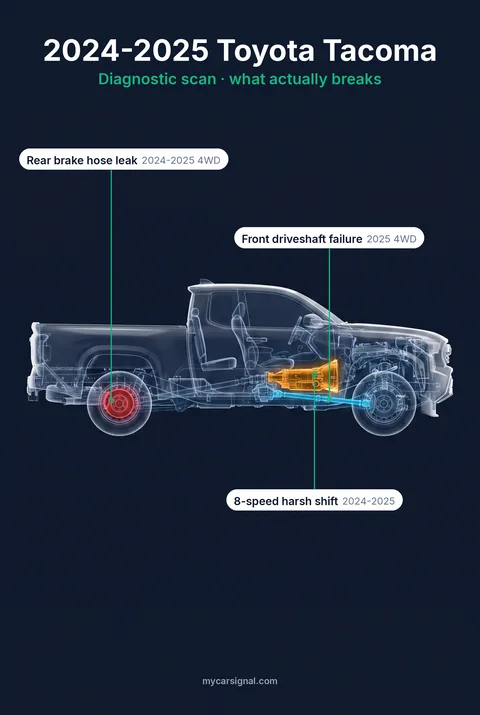
The 4th-gen Tacoma landed in 2024 with a new turbo engine, a new 8-speed automatic, and one glaring early problem: that transmission. Owners started reporting harsh shifting, slipping gears, and outright failures within weeks of launch. Some trucks showed symptoms with fewer than 1,000 miles on them. If you're shopping a used 2024 or 2025 Tacoma, this is the thing to understand before anything else.
Keep the timeline in mind. This generation is only two model years old, so there's no high-mileage track record yet. No rust-out data, no 150,000-km failure patterns like the old Tacomas built. Almost everything documented so far is early-production trouble, not aged-vehicle wear.
The 8-speed automatic is the headline problem
Reports of delayed shifting, shuddering, jerking, power loss, and even metal shavings in the transmission fluid piled up fast after the 2024 launch. Toyota issued an official technical service bulletin in September 2024 covering automatic models throwing a check-engine light with one or more trouble codes. In October 2024 that bulletin was extended to cover the i-FORCE MAX hybrid too, so the hybrid isn't a way around the issue.
Toyota's fix isn't a rebuild. The remedy is to swap the entire transmission assembly and torque converter, covered under the 5-year/60,000-mile powertrain warranty. A limited repair (no metal shavings) has been quoted in the $300 to $1,400 USD range as a best case, but a full replacement is a much bigger job, and some owners reported long waits for backordered units. One forum poster shared a dealer quote north of $27,000 USD for a full replacement. That was covered under warranty for that owner, so don't read it as a typical out-of-pocket bill. Read it as what the part is actually worth.
Here's where price matters. The median 2024 sits at $51,336 and a 2025 runs about $55,995. The saving on a cheaper early truck evaporates the moment you're outside warranty coverage on a transmission this expensive to replace. Warranty status should drive your decision more than the sticker.
Recalls, and one that isn't this generation's
The 4th gen has collected several recalls in its short life. The biggest by count is a rear brake hose leak risk on 4WD trucks with 16-inch brakes and 17-inch Toyota wheels, where mud and dirt build up in the clearance and damage the hose. It was later expanded to include some 2WD trucks and 18-inch wheel combos. In Canada that recall covers 11,086 vehicles across two batches.
| Issue | Years / scope | Type |
|---|---|---|
| 8-speed automatic failure / harsh shift | 2024–2025, auto + hybrid | TSB, warranty repair |
| Rear brake hose leak | 2024–2025 4WD (and some 2WD), specific wheels | Recall |
| Front driveshaft joint defect | 2025 4WD only (~6,000 trucks) | Recall (NHTSA 25V656) |
| Shock absorber oil reservoir corrosion | 2024–2025 TRD Off-Road (~48,000 US) | Recall |
| Manual (RC60F) gear lockout | 2024 | TSB |
Two more worth flagging. A 2025-only recall covers front driveshaft joints that can deform or break, roughly 6,000 4WD trucks, with steering and rollaway risk. And TRD Off-Road trucks from 2024–2025 have a shock absorber corrosion recall (about 48,000 in the US) where the oil reservoir can detach over time. One thing that gets confused a lot: the huge 381,000-vehicle rear-axle-bolt recall is 3rd-gen (2022–2023 trucks), not this generation. Don't let that one scare you off a 4th-gen truck.
Smaller gripes and one watch item
The manual RC60F transmission has its own smaller bulletin for a condition where the truck won't shift into 2nd, 4th, or 6th gear. It looks rare. Most manual owners complain about the wide 1st-to-2nd gear gap and clutch feel, not actual failures. There are also scattered infotainment glitches, with Consumer Reports owners noting the display or head unit stopping and needing replacement.
The turbo 2.4L (T24A-FTS) has no confirmed failure pattern yet. A 2026 overview says it hasn't had the trouble the Tundra's engine did, but flags low-tension piston rings as a possible long-term oil-consumption concern. That's an industry-wide design trait, not a Tacoma-specific defect, and it's a monitor-it item rather than a known fault. Stop-driving symptoms to watch for on any turbo engine: heavy smoke, rapid oil loss, grinding, a siren-like noise, overheating, or an oil-pressure warning.
What owners actually like
The off-road hardware gets consistent praise. Multi-Terrain Select with Dirt, Mud, and Rock modes, up to 11 inches of ground clearance, and a 34.4-degree approach angle. Toyota finally swapped the old rear drums for discs in 2024, so braking is a real upgrade. The i-FORCE MAX hybrid makes 326 hp and 465 lb-ft, though owner sentiment on it is mixed. The small 1.87-kWh battery gives it no real EV mode and only about 2 mpg better city economy, while adding weight, complexity, and cutting payload and towing. Plenty of enthusiasts prefer the simpler turbo four for exactly that reason.
Consumer Reports rates the 2024 Tacoma more reliable than the average vehicle from its model year, which is a solid signal from a big survey. Buy with that in mind, but do the homework the transmission problem demands. Check the specific VIN against Toyota's production-change cutoff rather than assuming 2024 is bad and 2025 is good. Confirm remaining powertrain warranty. On a test drive, focus on cold-start behavior, since hesitation and harsh shifts often show up then. If it's a 2025 4WD, verify the driveshaft recall was completed. And on any TRD Off-Road, check the shock recall status before you sign.
What these Toyota Tacoma years cost right now
Live Canadian price benchmarks for every year in this generation: