The second-generation Tacoma has a reputation for running forever, and most of that reputation is earned. But there's one problem that turns a bulletproof truck into a $15,000 headache, and every Canadian buyer needs to understand it before signing anything. It's the frame.
Frame corrosion: the issue that defines this truck
A Canada-wide class action targeted 2005–2010 Tacoma frames for what the filing called "excessive and premature rust corrosion, which render the vehicles unstable and unsafe." This is the real deal. Replacing a rotted frame can run upwards of $15,000, which is more than most of these trucks are worth on the used market.
Toyota settled without admitting fault and set up a free Frame Inspection and Replacement Program. A dealer inspects the frame, and if it meets the Rust Perforation Standard (a 10-millimetre or larger perforation), Toyota replaces the frame and associated parts at no cost. Trucks that don't hit that threshold got evaluated for a corrosion-resistant coating instead. Here's the catch: the program ran on a time limit, more like a warranty extension than an open-ended recall. Transport Canada never issued a formal recall because it decided the rust develops slowly and is visible from underneath years before the frame becomes dangerous.
So on the used market in 2025, this is not a solved problem. One forum owner discovered severe frame rust on a 2008 2.7L single cab after the inspection window had already closed. If you're looking at a 2005–2010 truck, get under it with a flashlight or pay a mechanic to. Poke the frame rails, the leaf-spring hangers, and the crossmembers. Flaking surface rust is normal; scaly, thick, perforated steel is a walk-away.
The leaf-spring recall and other early-year actions
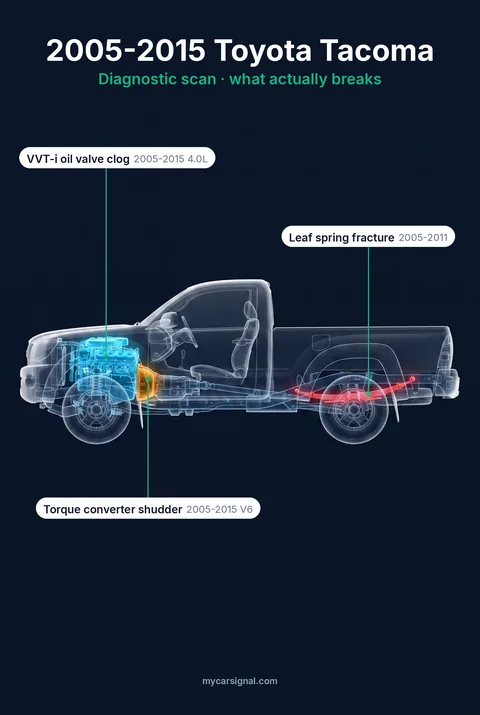
Related to the rust story, 2005–2011 Tacomas were recalled for leaf springs that could fracture from stress or corrosion. A broken leaf can shift out of position and contact the fuel tank, potentially puncturing it. That's a fire risk, not a nuisance, so confirm the recall work was done.
Recall volume skews heavily toward the early years. NHTSA logged 10 recalls against the 2005 model year versus 4 for 2015, which lines up with the frame, leaf-spring, and airbag issues clustering in 2005–2010. The 2005–2006 trucks had a side/curtain/knee airbag inflator recall from improper assembly, and a larger frontal airbag campaign in 2012 covered 2005–2009 trucks (roughly 495,000 units). Consumer Reports flatly rates the 2005 as less reliable than other vehicles of its year. If you want the fewest headaches, later is better here.
Transmission shudder on the V6 automatic
The second most common documented issue is a shudder in the A750F automatic. Owners describe it hitting between 32 and 42 mph, usually on the 2-3 shift. The cause traces back to the torque converter, and it's often the WS transmission fluid gone old, thin, or dirty. Toyota knew about it early: a 2006 owner was told a fix was in the works, and an 2008 Prerunner owner got the same story about a TSB covering torque converter lockup and flex plate issues.
The fix isn't always cheap or clean. One owner paid over $1,600 in parts and labour for a torque converter replacement, and the shudder came back until the transmission fluid got a full flush. If you're test driving a V6 automatic, take it to highway speed and pay attention right through that 2-3 shift. A faint vibration you can feel through the seat is the tell.
The 4.0L V6 and its oil habits
The 1GR-FE 4.0L V6 runs across the whole generation, and it lives and dies on clean oil. Its VVT-i system leans hard on oil pressure and cleanliness. The weak point is the oil control valves and their small mesh filters, which clog with sludge when oil changes get stretched out. A clogged filter starves the VVT actuator, throws a timing code like P0012, and can cause hard starting where the engine fires and stalls a few times before it catches. In timing-chain-related cases you'll hear a rattle.
One engine-review source is harsher than the owner crowd, arguing the block's cast-in thin cylinder liners can't be bored, so a damaged cylinder wall means the engine can't be rebuilt. Treat that as one technical opinion, not settled fact. The Tacoma owner community overwhelmingly calls this engine bulletproof. The practical lesson is the same either way: buy a truck with proof of frequent oil changes, and keep them frequent yourself.
What owners consistently love, and the small stuff
Owners are loud about core durability. One long-term 2013 V6 owner called it "rough around the edges" but "hands down the most reliable truck I have ever driven." Consumer Reports described the late-generation truck as "utilitarian, practically bulletproof," excelling at hauling, towing, and off-road use, with the smooth V6 as its saving grace. The recurring gripes are wear items and nuisances, not disasters: wheel bearings that need replacing, a temperature gauge that dies from a hot solder disconnect, clearcoat that peels, and AC units that quit. A few owners find the V6 feels sluggish off the line, but nobody's questioning whether it'll last.
Also worth knowing: ball joint wear is a Tacoma-nameplate issue that Toyota eventually covered with a warranty enhancement running to November 30, 2015. That program is now closed, so factor a worn ball joint into your inspection.
Which years to buy, and what the prices tell you
| Year | Median price (CAD) | Median km | Frame program? |
|---|---|---|---|
| 2007 | $12,998 | 367,690 | Yes (2005–2010) |
| 2009 | $15,710 | 257,500 | Yes |
| 2010 | $15,999 | 283,000 | Yes |
| 2011 | $23,650 | 184,000 | No |
| 2012 | $21,392 | 238,500 | No |
| 2013 | $23,846 | 195,596 | No |
| 2015 | $23,448 | 211,220 | No |
Notice the price jump. The 2007 sits at a median of $12,998, while a 2011 lands at $23,650. That gap isn't random. The cheap early trucks are exactly the ones inside the 2005–2010 frame-rust window, and a frame job that Toyota won't pay for anymore can cost more than the truck. The saving on a $13,000 cheap one vanishes instantly if the frame is gone.
My read: if you can stretch to a 2011 or newer, you step clear of the frame-corrosion program cutoff entirely, and you're buying into the years with lighter recall history. On any V6 automatic, test the 2-3 shift for shudder. On any 2005–2010 truck, the frame inspection isn't optional, it's the whole decision. Buy the one with oil-change records and a clean underside, and this truck will outlast almost anything else in the segment.
What these Toyota Tacoma years cost right now
Live Canadian price benchmarks for every year in this generation:
2007 Tacoma prices2009 Tacoma prices2010 Tacoma prices2012 Tacoma prices2013 Tacoma prices2015 Tacoma prices