The JK Wrangler is one of the most capable off-roaders you can buy used, and Jeep owners rarely apologize for it. But the reliability record across 2007 to 2018 is uneven, and the gap between a good year and a rough one is real money. Here's what actually breaks, which years it hits, and where to spend your attention when you go look at one.
The problems that define this generation
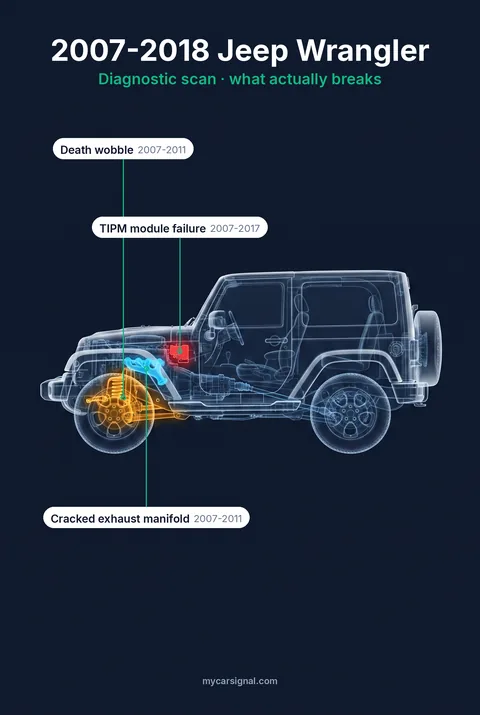
Start with the death wobble, because it's the one every Wrangler shopper has heard about. Hit a bump or pothole at roughly 45 to 65 mph and the front axle can start shaking violently, feeding on itself until you slow down. It comes from worn or badly torqued track bar, tie rod ends, ball joints, or the steering stabilizer on the solid front axle. It's most pronounced on 2007 through 2011 JKs. Chrysler's official answer was TSB 08-092-20, which called for a steering stabilizer swap. Critics see that as a band-aid that hides the underlying geometry and wear problem rather than fixing it. A focused repair on the worn parts runs about $500 to $1,500 USD. A full sort-out with upgraded components can hit $2,000 to $3,500 USD.
Then there's the TIPM, the Totally Integrated Power Module. It runs your power windows, fuel pump, starter, lighting, and climate control, so when it goes bad the symptoms are all over the place. Stuck windows. Random airbag warnings. Stalling. No-start conditions. It's reported across 2007 to 2017, with 2012 called out as the worst year for electrical trouble. Replacement usually lands around $1,200 USD.
Engines: the 3.8 versus the Pentastar
The engine story splits cleanly in two. The 3.8L V6 in 2007 through 2011 has a weak reputation, with reported oil consumption and an average annual repair figure near $1,123 USD from one aggregator. Cracked exhaust manifolds are widely reported on it too, blamed on the metal crystallizing over years of heat cycles.
The 3.6L Pentastar arrived for 2012 and is the better long-term engine once it matured. Early ones weren't clean, though. The 2012 and 2013 cars, with some 2014 reports, show camshaft position sensor failures throwing P0344 codes, which causes stalling and hard, rough starts. That's a genuine safety concern. Owners on the early Pentastars also reported oil contamination, valve opening failures, misfires, rough idle, and in some cases metal shavings in the oil. Oil filter housing and valve cover gasket leaks show up on Pentastar JKs as well. And the exhaust manifold crack isn't a 3.8-only issue: 3.6 owners report it too, with the manifold covered only by a short 2-year/24,000-mile warranty. Figure around $1,000 USD to fix a cracked manifold.
| Problem | Years hit hardest | Typical cost (USD) |
|---|---|---|
| Death wobble (steering/front axle) | 2007-2011 | $500-3,500 |
| TIPM electrical failure | 2007-2017 (2012 worst) | ~$1,200 |
| 3.8L oil use / manifold cracks | 2007-2011 | ~$1,000-1,123/yr |
| Pentastar cam sensor / valve issues | 2012-2014 | varies |
| Exhaust manifold crack (3.6L) | 2012+ | ~$1,000 |
Recalls, fuel, and airbags
A couple of recalls matter here. The 2007-2008 cars with the 42RLE automatic had a park-pawl defect, recall 05V460000, where a badly installed cup plug could let the anchor shaft move so the truck couldn't reach Park. Some 2008 units also left the factory missing the transmission fluid temperature sensor. On the fuel side, 2007 and 2010 owners reported gasoline spraying back out during refueling, tied to cracked rollover valves and failing plastic tank fittings. One source says the recall covered only early 2007 units while the same defect carried into later cars unaddressed, so treat that claim with caution but check the filler behavior yourself.
Airbags are the bigger one. Clockspring failures and airbag warning lights show up across 2007 to 2012, and those same years are caught up in both the Takata inflator recall and a separate passenger frontal airbag propellant-degradation campaign where the bag could deploy with more force than intended. If you're looking at an early JK, confirm every airbag recall has been closed out at a dealer. Water leaks around the A-pillar and doors, plus failing window regulators and lock actuators, round out the nuisance list on the removable-door design.
What owners actually like, and which years to buy
The praise is consistent. The Pentastar, once past its early-year gremlins, is called one of the most reliable engines on the market after more than 10 million built across the lineup. Solid axles and a simple mechanical layout make the JK durable and easy to fix compared to electronics-heavy rivals. Resale holds up. And the late years are the ones people point to: Autoblog flat-out says buy a 2017 if you want the most sorted version of the old formula, and 2015 through 2017 score higher across the board than the generation average. J.D. Power gave the JK a peak of 78/100.
Price-wise, the cheap early cars carry the risk. A 2008 sits at a $7,995 median, but it's the death-wobble, park-pawl, airbag-recall era, and a single death-wobble fix or TIPM replacement wipes out the saving over a sorted later truck. The 2012 median of $12,500 looks tempting until you weigh the worst-year TIPM and early-Pentastar cam sensor reputation. The stronger buys are the 2015 at $19,900, the 2016 at $19,692, and the 2017 at $21,997. The 2018 at $24,997 is worth a caution: 2018 was sold as both the final JK and the first JL, and a lot of the "2018 problems" you'll read about (steering wander, Uconnect reboots) belong to the new JL, not the outgoing JK. Confirm which one you're actually looking at.
If you're test-driving an early JK, get it to highway speed over rough pavement and feel for any front-end shake, cycle every power window, and pull the recall history by VIN through a dealer before you hand over money. On a 2012-2014 Pentastar, watch for stalling or a rough cold start and pull the oil cap to check for contamination. And if you want the least drama for the money, aim at 2015 through 2017.