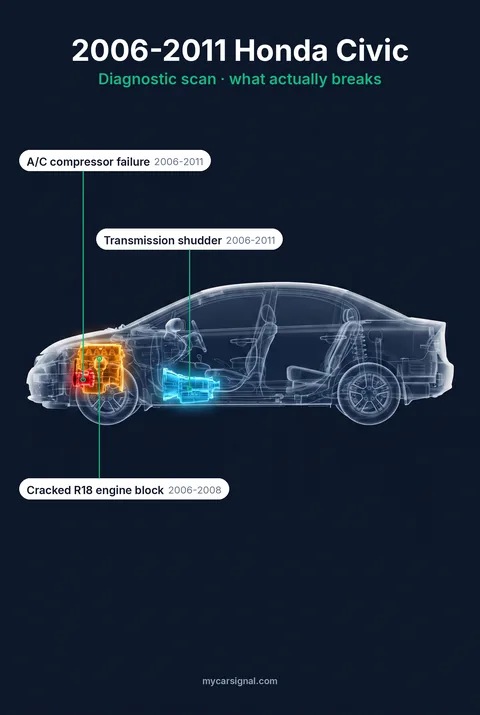
The 8th-gen Civic earned its reputation honestly. These cars regularly clear 300,000 km on basic maintenance, and the average annual repair bill across the Civic nameplate sits around $368. But there's one hard failure that separates a great buy from a money pit, and it lands almost entirely on the earliest cars in this run.
The cracked engine block (2006–2007, some 2008)
This is the big one. The base 1.8L R18 engine in the non-Si trims (DX, LX, EX) can develop a small crack in the block that leaks coolant. The 2006 Civic alone has 183 reported cases, showing up around 158,000 km with an average repair cost near $2,910 USD. Honda documented it in TSB 08-044 and quietly extended block warranty coverage as a goodwill move, so some owners got the fix free. That coverage is long gone now.
Two things matter here. First, the crack is specific to the R18 engine, so the Si's K20Z3 2.0L is not affected. Second, this is concentrated on 2006 and 2007 cars, plus a handful of 2008s. Those same two years also carry the highest complaint volumes of any Civic model year on record. If you're looking at an early car, get the coolant system checked cold and warm before you sign anything.
What breaks across the whole generation
The A/C compressor is a known wear point on these years, but in a specific way. It's the clutch and bearing that go, not the internals, and a full replacement at an independent shop runs $700 to $1,100 USD with a reman compressor (the drier and expansion valve should go in at the same time). Some "A/C dead" complaints trace to a cheaper culprit: a failed thermal overload switch on the compressor housing. Worth diagnosing before you assume the whole unit is toast.
Automatic transmission shudder shifting from 2nd to 3rd is common and, honestly, usually not scary. Plenty of owners fixed it with a simple ATF change. The trap is assuming that's always the case. One 2006 Si owner had shift trouble from new, and the clutch let go at 108,000 km, with a dealer quote near $1,900 USD versus $1,140 at an independent. Shudder around 25 km/h can also point to a valve body or speed sensor. Test drive it and pay attention to that gear change.
Then there's the rear tire wear. Honda TSB 08-001 admits the stock tire and rear suspension geometry combo chews through rear tires unevenly, often with a roaring noise or highway vibration. Rear camber isn't factory-adjustable on these cars, so a real fix means an aftermarket camber kit. Budget for it if the seller's rear tires look feathered.
| Problem | Years affected | Typical fix |
|---|---|---|
| Cracked R18 engine block | 2006–2007, some 2008 (non-Si) | ~$2,910 USD, block replacement |
| A/C compressor clutch/bearing | 2006–2011 | $700–$1,100 USD |
| Transmission shudder (2nd–3rd) | 2006–2011 | ATF change to ~$1,900 clutch |
| Rear tire wear (geometry) | 2006–2010 | Aftermarket camber kit |
| Clear-coat cracking/peeling | 2006–2011, worse on dark colors | Was TSB coverage in 2013 |
| Door lock actuators | 2006–2011 | ~$300 dealer per door |
Paint, door locks, and the airbag recall
The clear-coat problem is one of the most repeated complaints. The paint on the roof and front fender edges cracks or goes chalky and cloudy, worst on blue and black cars. Honda issued paint TSBs in 2013 offering free repaint at dealers, but that window has closed. Assume any repair now comes out of your pocket, and look hard at the roof and upper panels in daylight.
Door lock actuators wear out too. The little motor or plastic gears inside give up, and a door starts failing to lock intermittently, sometimes for a month, then working again. It's a nuisance, not a safety issue, and aftermarket parts cost a fraction of the ~$300 per door a dealer quotes.
On the safety side, the Takata passenger airbag inflator recall (NHTSA 16V-346) covers every 2006–2011 Civic and Civic Hybrid. There was also a follow-up recall for cars where a dealership installed the replacement inflator incorrectly, plus an earlier fuel filler neck hose clamp recall on certain sedans and coupes. Run the VIN and confirm all recall work is done before you buy.
The Hybrid is its own animal
If you're eyeing a 2006–2011 Civic Hybrid, the IMA battery is the story. Degradation is a well-known owner headache, and premature failure often fell outside the 8-year/80,000-mile factory battery warranty. Replacement runs roughly $999 to $1,499 USD for reman-to-new cell options, versus about $3,000 at a dealer. The Hybrid also has the transmission shudder complaint, and CarComplaints flags transmission as its worst category, with 2006 the most-complained year.
What to buy and what to check
The cleanest play is a 2009 or 2010 gas car past the block issue years. On the Canadian market the 2010 median sits at $6,500 around 169,000 km, and the 2009 runs about $8,500. The earlier cars look cheaper on paper: the 2007 median is $6,000 and the 2008 is $6,411. But a cracked block repair near $2,900 wipes out that saving and then some, so a slightly pricier post-2008 car is the safer money.
Whatever year you look at, check the coolant system on the R18 cars, feel for the 2nd-to-3rd shudder on a real test drive, inspect rear tire wear, look at the roof and fenders in sunlight, and confirm the Takata airbag work is complete. If you want the engine that dodges the block problem entirely, the Si's K20Z3 is the one, just know you're paying for the performance too.
What these Honda Civic years cost right now
Live Canadian price benchmarks for every year in this generation: